
MEDICAL
Shots and Clozapine Beat the Usual Pill After Cannabis Psychosis
Swedish registries find monthly antipsychotic shots and clozapine cut cannabis psychosis hospital returns, while the usual olanzapine pill barely moves relapse.

A Swedish registry of 1,820 people with first-episode psychosis and cannabis use disorder found any antipsychotic linked to a 33 percent lower risk of a later psychosis admission. The drugs that moved that number were monthly shots and clozapine, not the olanzapine pills most patients received.
Wire copy framed the work as a fix for marijuana-induced psychosis. The cohort is dual diagnosis. A later paper from the same lab, on true cannabis-induced psychosis, shows the same pattern, and a cannabis diagnosis that does not leave the chart.
Sweden’s Registry Followed 1,820 Dual-Diagnosis Patients
Alexander Denissoff, MD, a psychiatrist at the University of Turku in Finland, led the 2024 analysis with colleagues who included Jari Tiihonen and Marta Di Forti. They used Swedish national registers from 2006 to 2021, not Finnish hospital files. The paper went online March 26, 2024, in Schizophrenia Bulletin.
The 1,820 people had a first non-affective psychotic episode, meaning the break was not driven by mania or depression, and a cannabis use disorder at the same time. Men made up 84.73 percent of the group. Mean age was 26.8 years. Mean follow-up was 6.13 years.
During that stretch, 1,111 of the 1,820 were admitted for psychotic relapse, 61 percent. Another 1,143 were admitted for a substance use disorder. The statistical model compared each person with himself during months on a given antipsychotic and months off it, which limits the usual problem that sicker patients get different prescriptions.
TWO LABELS THAT GET LUMPED TOGETHER
- FEP plus CUD: First-episode psychosis and a cannabis use disorder, the 2024 cohort, a dual-diagnosis group that often looks like early schizophrenia with heavy cannabis use.
- CIP: Cannabis-induced psychosis, coded F12.5, a substance-induced break that guidelines still treat as brief if symptoms fade after the drug clears.
- Why it matters: A person can meet one label, the other, or move between them, and the Swedish lab later ran both designs on the same registers.
Denissoff’s team wrote that cannabis use after a first episode is linked to worse symptoms, more relapses, and missed antipsychotic doses, and that improving care for these dual-disorder patients is of paramount importance because relapse after the index break tracks with poor clinical outcomes.
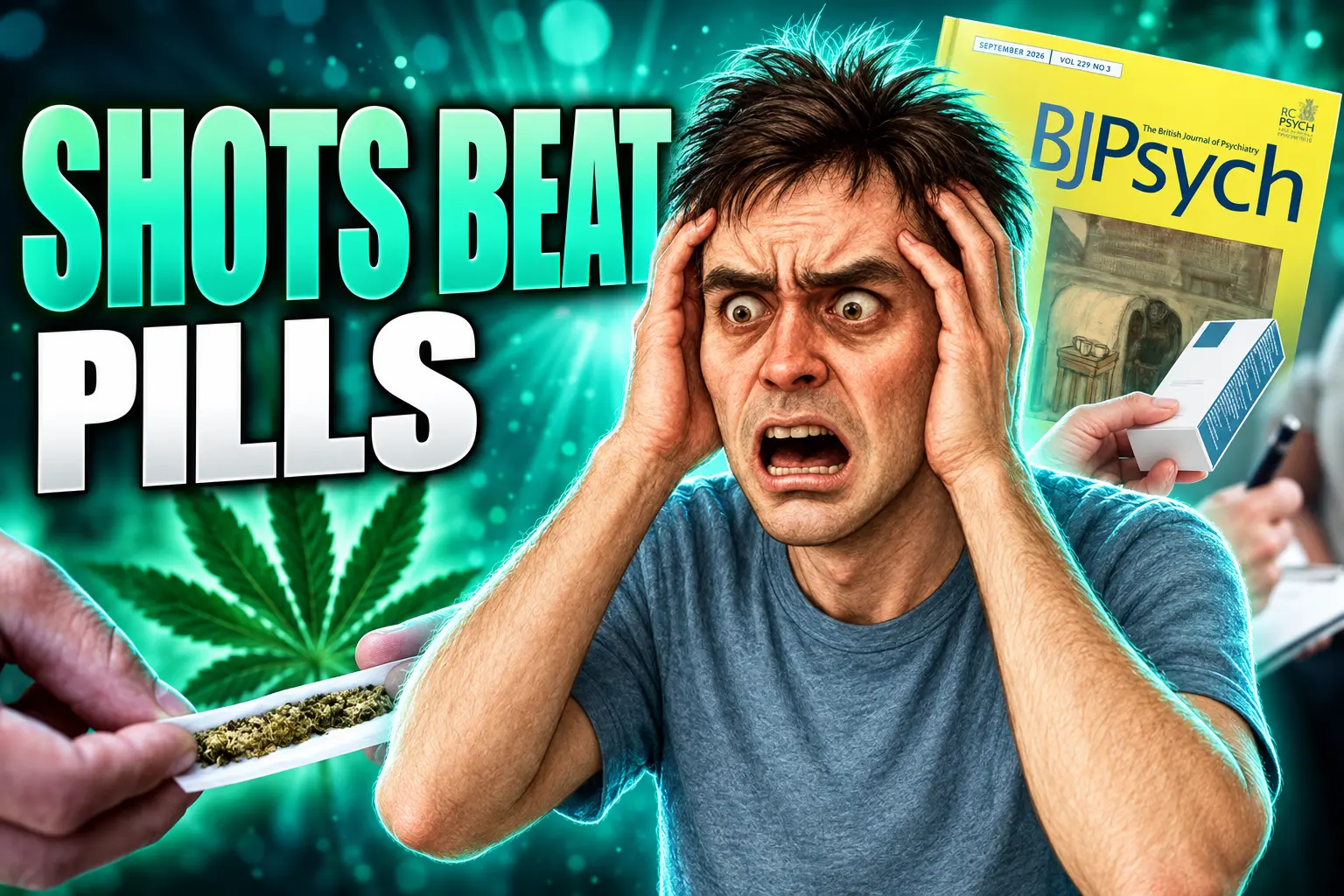
Long-Acting Shots Ranked Ahead of the Usual Pills
Use of any antipsychotic, versus none, was linked to a 33 percent lower risk of psychotic relapse (adjusted hazard ratio 0.67, 95 percent CI 0.60 to 0.75). That average hides a split between shots, clozapine, and the tablets that fill discharge bags.
Long-acting injectable risperidone ranked first for this outcome, aHR 0.40, a 60 percent lower risk. Injectable aripiprazole came next at 0.42 (58 percent). Oral clozapine was 0.43 (57 percent). Injectable paliperidone was 0.46 (54 percent). Oral aripiprazole was the strongest non-clozapine pill, aHR 0.61.
Injectable olanzapine did not clear statistical significance (aHR 0.61, CI 0.35 to 1.05). Oral quetiapine and oral risperidone were not found to prevent relapse admissions. Antipsychotic polytherapy, two or more drugs at once, was linked to a 40 percent lower psychotic-relapse risk (aHR 0.60), even though clinical guidelines have often discouraged that approach.
2024 COHORT, PSYCHOTIC RELAPSE VERSUS NO ANTIPSYCHOTIC
| Treatment | Adjusted hazard ratio | Change in relapse admission risk |
|---|---|---|
| Any antipsychotic | 0.67 | 33% lower |
| Risperidone LAI | 0.40 | 60% lower |
| Aripiprazole LAI | 0.42 | 58% lower |
| Oral clozapine | 0.43 | 57% lower |
| Paliperidone LAI | 0.46 | 54% lower |
| Antipsychotic polytherapy | 0.60 | 40% lower |
| Oral aripiprazole | 0.61 | 39% lower |
| Olanzapine LAI | 0.61 | Not significant |
Oral olanzapine was the most used drug, prescribed to 1,038 of the 1,820 patients. The authors called its effect on these outcomes modest, and said that surprised them because other first-episode studies have ranked olanzapine among the stronger non-clozapine options.
Clozapine Cut Substance-Use Returns by 86%
The secondary outcome is the one cannabis clinics feel. Clozapine was linked to an 86 percent lower risk of a later substance-use admission (aHR 0.14, CI 0.05 to 0.44). Injectable risperidone followed at 67 percent lower (aHR 0.33). Injectable paliperidone was 63 percent lower (aHR 0.37). Any antipsychotic, as a class, was linked to a 24 percent lower SUD-admission risk (aHR 0.76).
Denissoff’s group warned that the clozapine finding might not be void of selection bias. Patients who reach clozapine have already survived other drugs, blood monitoring, and a service that can run that protocol. The same paper still ranked clozapine with the long-acting shots as the combination worth using early in this dual-diagnosis group.
That is a hard sell on a first admission. Clozapine is usually reserved for psychosis that has not responded to other antipsychotics, and it requires regular neutrophil counts because of a rare drop in white cells. The registry is not a randomized trial. It is a map of what happened when Swedish services used the drugs they already had.
The Same Lab Then Tested Cannabis-Induced Psychosis
Antti Mustonen and many of the same co-authors, Denissoff included, then asked the question the 2024 title never did. They sampled 1,772 people aged 16 to 64 with a first clinically diagnosed cannabis-induced psychosis (ICD-10 F12.5) between 2006 and 2021, with no earlier substance-induced psychosis, schizophrenia-spectrum disorder, or bipolar diagnosis on file.
The British Journal of Psychiatry published the paper in volume 228, pages 317 to 323. Men made up 84.1 percent (1,490 people). Mean age at first diagnosis was 26.6 years. Mean follow-up was 8.26 years, running through December 2023. The design was again within-person Cox models, on drug versus off drug.
Of that CIP group, 1,343 people (75.8 percent) used an antipsychotic at some point. Psychosis admissions still hit 914 people, 51.3 percent. Those 914 people generated 3,920 psychosis admissions. Primary psychotic disorder accounted for 57.2 percent of those stays. Unspecified non-organic psychosis was 23.5 percent, CIP again 23.0 percent, and schizophrenia 17.9 percent.
Any antipsychotic was linked to a 25 percent lower risk of a psychosis admission (aHR 0.75, CI 0.67 to 0.84). The shots that stood out here were aripiprazole LAI at 0.27 (73 percent lower) and olanzapine LAI at 0.28 (72 percent lower). Clozapine was 0.55 (45 percent). Oral aripiprazole was 0.64 (36 percent). Oral olanzapine, used by 1,013 people, 57.2 percent of the sample, was 0.81, a 19 percent lower risk.
Risperidone LAI, paliperidone LAI, oral risperidone, and quetiapine did not reach significance for CIP psychosis relapse. That is the reverse of the 2024 ranking on risperidone shots, and a reminder that these are observational slices, not a head-to-head contest.
What pharmacological treatments are most effective in preventing relapse after cannabis-induced psychosis?🚨
2025 Study 👇
Swedish cohort study of 1,772 patients with a first diagnosis of cannabis-induced psychosis (CIP) explored the role of antipsychotics in preventing… pic.twitter.com/ELa9qNCZbK
— Dr Sanil Rege FRANZCP | MRCPsych (@sanilrege) May 9, 2025
TWO SWEDISH COHORTS, SAME REGISTERS
| Measure | 2024 FEP plus CUD | 2026 CIP |
|---|---|---|
| People | 1,820 | 1,772 |
| Share who were men | 84.73% | 84.1% |
| Mean age | 26.8 years | 26.6 years |
| Mean follow-up | 6.13 years | 8.26 years |
| Psychosis readmission | 1,111 people (61%) | 914 people (51.3%) |
| Any antipsychotic, psychosis | 33% lower risk | 25% lower risk |
| Standout LAI, psychosis | Risperidone LAI, 60% lower | Aripiprazole LAI, 73% lower |
| Clozapine, SUD admission | 86% lower risk | 73% lower risk |
| Most used oral drug | Olanzapine, 1,038 people | Olanzapine, 1,013 people (57.2%) |
For CIP substance-use admissions, 1,021 people (57.6 percent) came back. Clozapine again led (aHR 0.27, 73 percent lower), then olanzapine LAI (0.39) and aripiprazole LAI (0.42). Any antipsychotic was linked to a 22 percent lower SUD-admission risk (aHR 0.78). Somatic, non-psychiatric admissions hit 306 people (17.2 percent). Any antipsychotic was linked to a lower somatic-admission risk (aHR 0.58), and no individual drug showed a rise, though several shots had too few events to judge.
Why a Shot Changes the Odds After Cannabis Psychosis
Mustonen’s group noted that cannabis use is tied to missed doses in psychotic illness, and that expert statements already push long-acting shots in first-episode psychosis. Their CIP results, they wrote, suggest that advice still holds when the discharge diagnosis is cannabis-induced.
On the two standout shots, they reported a 72 to 73 percent lower psychosis-relapse risk against 19 to 36 percent for the same molecules as pills. Risperidone followed the same shape even where it missed significance, LAI 48 percent versus oral 9 percent. They argued that the type of antipsychotic, not only whether the patient swallows it, may change relapse risk after CIP.
These findings encourage the early use of second-generation long-acting injectables as an important secondary prevention strategy to reduce rates of hospitalization in first-episode patients with comorbid cannabis use disorders.
Alexander Denissoff, MD, University of Turku, Schizophrenia Bulletin 2024
Some clinicians still treat a first cannabis-linked break as a short intoxication that will clear if the plant is removed. Mustonen’s introduction is blunt about the gap: diagnostic guides still describe substance-induced psychosis as a brief syndrome around use, and they do not say how, or how long, to prescribe an antipsychotic after CIP.
Older work already showed that stopping cannabis after a first psychotic episode tracks with better long-term function and fewer negative symptoms than staying on the drug. The new registers cannot see whether a patient kept using. They can see which prescription was active when the next admission landed.
Most Patients Still Carried a Cannabis Diagnosis
The hole in both papers is the same. There is no lab value, no purchase log, no self-report of THC dose after the index stay. What the CIP file does show is that cannabis did not drop out of the record.
CANNABIS CODES AFTER THE FIRST CIP STAY
- Any cannabis code: 1,235 people (69.7 percent) received another F12.x diagnosis during follow-up.
- CIP again: 921 people (52.0 percent) were recoded F12.5.
- Harmful use: 495 people (27.9 percent) received F12.1.
- Dependence: 488 people (27.5 percent) received F12.2.
Mustonen cited a meta-analysis by Murrie and colleagues that found CIP has the worst conversion to schizophrenia among substance-induced psychoses, about one in three. In this CIP sample, 17.9 percent of the later psychosis admissions were already coded as schizophrenia. Those are different counts, one a published conversion share, the other a share of hospital stays, and they both point away from a one-night story.
The 2024 paper’s own limits, listed by the authors, include no cannabis-use path during follow-up, possible missed CUD diagnoses, and a cohort that may not match people with lighter use. Denissoff still tied multiple later episodes to staying on cannabis after the first break, or not taking the antipsychotic as prescribed. The registers measure the second half of that sentence more cleanly than the first.
Families Meet the Same Ward Door Again
Parents who have lived through these admissions describe a loop the tables only imply. A young man is brought in paranoid or hearing voices, often after high-THC vapes or concentrates. The ward starts an oral antipsychotic, often olanzapine because it is on the shelf and sedating. He is calmer in three days. He goes home. The cannabis supply is still around the corner. The next stay is coded as non-adherence, or as schizophrenia, or as CIP again.
That loop is why a monthly injection can look stronger than the same molecule in a bottle. It is also why clozapine keeps showing up on the substance-use rows. Mustonen noted prior work in which clozapine and olanzapine were tied to less cannabis craving than risperidone in people with schizophrenia, then said the evidence is still too thin for a craving-based prescribing rule.
Psychiatrists circulating the CIP paper have focused on the shots. A smaller group argues that calling the next diagnosis schizophrenia is a mislabel for untreated addiction. The Swedish files cannot settle that fight. They can show that 75.8 percent of CIP patients received antipsychotics even though, as Mustonen wrote, no guideline tells doctors how to prescribe them after this diagnosis, and that oral olanzapine was still the default.
Almost three-quarters of the sample had used antipsychotics after their first episode of CIP. This is interesting, as there are no guidelines to how antipsychotic treatment should be prescribed after CIP.
Antti Mustonen and colleagues, British Journal of Psychiatry, volume 228
Mustonen also flagged olanzapine’s metabolic and heart risks for long-term relapse prevention, even where the CIP psychosis and SUD rows looked better than nothing. The practical tension is ugly and specific. The pill most services reach for is the one with the weakest signal in the dual-diagnosis paper and a 19 percent signal in the CIP paper. The tools with the large associations are a shot the patient cannot skip and a drug many teams still will not start on admission one.
The registers see the syringe and the tablet. They still cannot see the gram that followed the patient home.
Frequently Asked Questions
What Is the Difference Between Cannabis-Induced Psychosis and Schizophrenia?
Under DSM-5 rules for cannabis-induced psychotic disorder, delusions or hallucinations start during or soon after intoxication, are severe enough to need care, and are not better explained by a primary psychotic illness. If the full syndrome was already present before heavy use, or if psychotic symptoms last more than about four weeks after the cannabis is gone, manuals point toward an independent disorder such as schizophrenia rather than a purely substance-induced break.
How Often Does Cannabis-Induced Psychosis Become Schizophrenia?
A meta-analysis by Murrie and colleagues, cited in the 2026 CIP paper, found that about one in three people with cannabis-induced psychosis later meet criteria for schizophrenia, the highest conversion share among substance-induced psychoses. Other reviews have published ranges from roughly 25 to 45 percent, and some cannabis-specific series have reported figures near 46 percent. Conversion is more often described in young men and in people with a family history of psychosis.
Are Long-Acting Injectable Antipsychotics Different Drugs From the Pills?
They are usually the same active drugs in a form that is injected every two to four weeks, or at similar intervals, so the dose does not depend on daily swallowing. Paliperidone is a related molecule to risperidone, its main metabolite, sold in both oral and injectable versions. In the CIP paper, aripiprazole and olanzapine looked far stronger as shots than as tablets, which the authors read as a missed-dose problem as much as a molecule problem.
Why Do Doctors Still Start Clozapine After Cannabis Psychosis?
Clozapine is not a first-line discharge drug. It is used when other antipsychotics have failed, and it needs repeated neutrophil blood tests because of a rare, dangerous fall in white cells. In both Swedish cohorts it was the oral drug most tightly linked to fewer substance-use admissions, 86 percent lower risk in first-episode psychosis with cannabis use disorder and 73 percent lower in CIP, which is why dual-diagnosis services keep putting it on the table despite the extra monitoring.
Disclaimer: This article is news reporting on published Swedish registry studies of antipsychotics after psychosis linked to cannabis use, and it is for information only. It is not medical advice, a diagnosis, or a recommendation to start, stop, or switch any antipsychotic, cannabis product, or other drug. Decisions about psychosis, cannabis use disorder, clozapine monitoring, or long-acting injections belong with a qualified psychiatrist or other licensed clinician who can review a patient’s full history, labs, and local prescribing rules. The figures here come from observational Swedish register papers covering 2006 to 2021, with CIP follow-up through December 2023, and hospital risks, drug availability, and product potency can differ by country and over time.

What Are the Effects of Combining Alcohol and Cannabis? A Canadian Evidence Guide

The Same Day GTI Sought DEA Medicine Status, a Class Action Hit

PharmaCann Closed the Olyphant Grow After the IIPR Handover

The OGeez Triple Infused Gummy Trails Peg’s RSO

Kentucky’s First Processor Unlocked Stores and Shut a Pardon

Sam the Skunkman Left Cannabis a Hidden Gene Pool
PharmaCann Closed the Olyphant Grow After the IIPR Handover

Ball Family Farms Bets a License on Hoodbaby’s Seed

The 1,500-Pound U-Haul Load Repeats Daley’s Prison Run
The Same Day GTI Sought DEA Medicine Status, a Class Action Hit
-
 CANNABIS2 years ago
Sam the Skunkman Left Cannabis a Hidden Gene Pool
-
 CANNABIS7 months ago
PharmaCann Closed the Olyphant Grow After the IIPR Handover
-
 CANNABIS1 year ago
Ball Family Farms Bets a License on Hoodbaby’s Seed
-
 MARIJUANA2 years ago
The 1,500-Pound U-Haul Load Repeats Daley’s Prison Run
-
 LAW6 months ago
The Same Day GTI Sought DEA Medicine Status, a Class Action Hit
-

 MEDICAL2 years ago
Aurora Pastilles Grew in Australia After Demand Turned
-
 CANNABIS10 months ago
Kentucky’s First Processor Unlocked Stores and Shut a Pardon
-
 CANNABIS1 year ago
Ahern Left the Cannabis Chair, Then the Lottery Collapsed