
CANNABIS
Sam the Skunkman Left Cannabis a Hidden Gene Pool
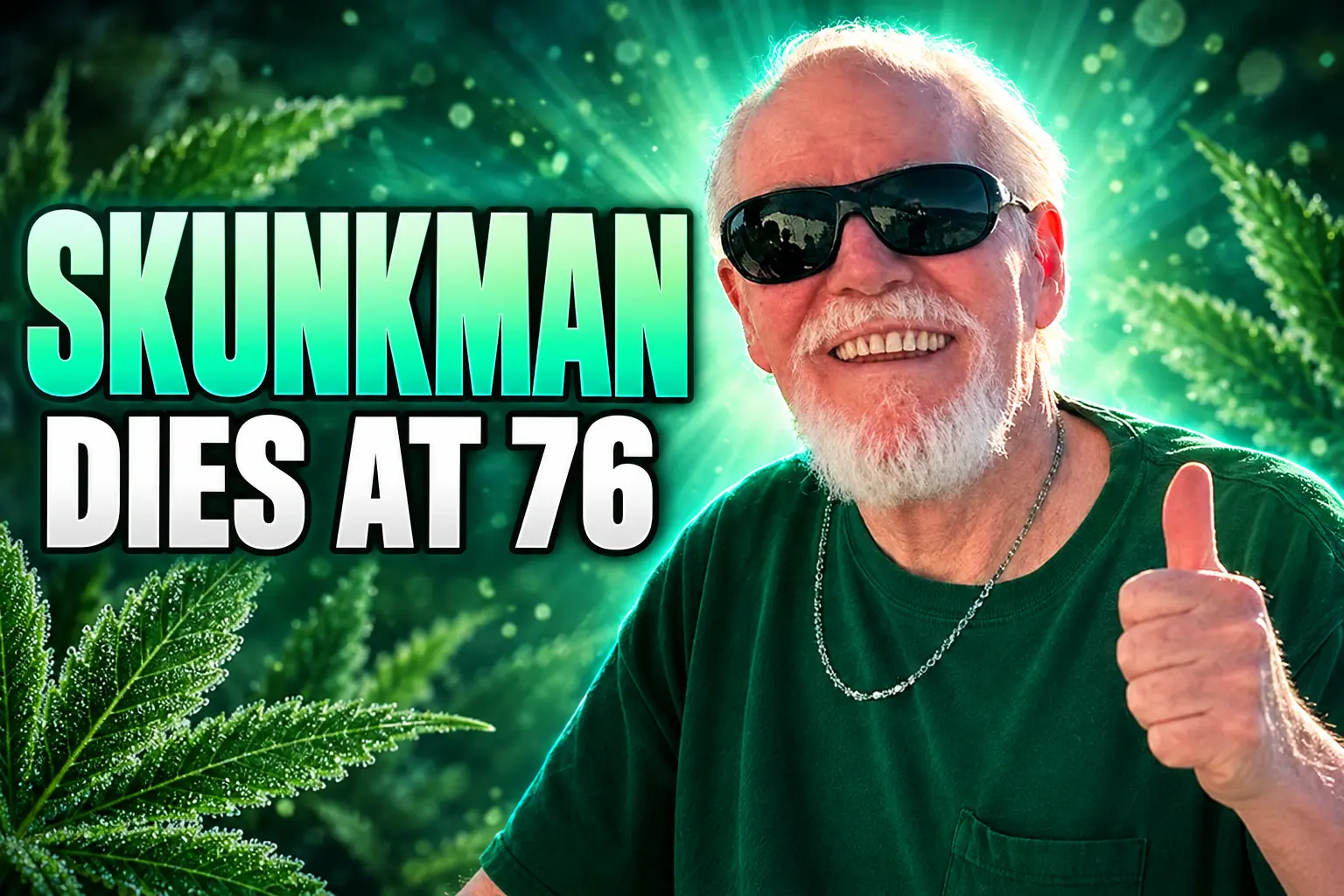
David Watson, known as Sam the Skunkman, died at 76 after building Skunk #1 and the Amsterdam seed library behind early CBD medicines.

David Paul Watson, the American breeder known as Sam the Skunkman, died on January 27, 2025, at 76. Friends in the grow scene learned it the next morning from Todd McCormick, the activist and photographer who had been expecting the couple for a month-long visit.
Watson spent the 1970s in Santa Cruz County turning imported landraces into a plant that would grow the same way twice. He spent the next four decades in Amsterdam handing those plants to Dutch seed companies and, later, to a licensed lab that sold its library to the British firm behind the first modern cannabinoid drugs. Most shoppers who still buy something called skunk never saw his face.
The Most Influential Breeder Almost Nobody Saw
The World of Cannabis Museum, whose founder Jair Velleman was a close friend, said Watson died on a Monday, the same calendar date on which medical-marijuana activist Dennis Peron had died seven years earlier. The museum called him, as many growers already did, the most influential cannabis breeder in history, and pointed to genetic fingerprints on most popular varieties.
Ryan Lee, the breeder behind Chimera Genetics, called him “the patriarch of the entire cannabis industry.” McCormick wrote that his passion and his contributions were “legendary.” Robert C. Clarke, the botanist who met him about 50 years earlier, wrote the family obituary and asked readers to honor him “with a moment of highness.”
SAM THE SKUNKMAN AT A GLANCE
- Died: January 27, 2025, at 76, with the public notice coming the next day.
- Partner: Diana, his wife of 54 years, who opened the door the day Clarke first knocked.
- Best-known work: Skunk #1, a true-breeding Afghan, Colombian, and Acapulco Gold hybrid.
- Later company: HortaPharm B.V. in Amsterdam, a licensed cannabinoid research grower.
He also answered to Skunkman Sam, Sam Selezny, and Sadu Sam. In 1979 he published a grow essay under the name Selgnij. The stack of aliases was not a party trick. It was how a man with a California record and a Dutch research license kept those two lives from colliding.
Skunk #1 Made Indoor Cannabis a Repeatable Crop
Before Skunk #1, a lot of homegrown started as bag seed. Height, smell, and finish date wandered from plant to plant. Watson and the loose Sacred Seeds circle in the Santa Cruz hills spent years crossing a stout Afghan indica with Colombian Gold and Acapulco Gold, then breeding the result back on itself until the offspring looked like one another.
Watson later put that recipe in writing. Skunk #1 “was a 3-way hybrid of Afghan X Colombian X Acapulco Gold,” he wrote, and unlike an earlier F1 cross, “these were true breeding,” meaning the plants grew out with the same physical traits. Horticulture writer Ed Rosenthal has a shorter version of the same point: the line is “in everything.”
What the plant actually changed was farm math. The Afghan cut the stretch and the wait. The two sativas kept a bright, hard smell and a usable high. Growers could flower it in a room, trim it without drowning in leaf, and sell a jar that smelled like the last jar. Super Skunk and the UK Cheese family are the descendants people still name out loud. A long tail of later hybrids sits behind them, often several crosses removed from the Santa Cruz work.
COMPANIES HE PUT ON THE MAP
| Venture | When | What it put into circulation |
|---|---|---|
| Sacred Seeds | Early 1970s, Santa Cruz County | Among the first U.S. cannabis seed catalogs, including Skunk #1 |
| Cultivator’s Choice | 1986, Amsterdam | The Dutch outlet for his California stock; Skunk #1 took the first Cannabis Cup |
| HortaPharm B.V. | Founded 1992; grow license 1997 | A licensed library of THC- and CBD-rich lines sold into medical research |
| Hortilab Seed Bank | Amsterdam, with Clarke | A later genetics shop alongside the Legends of Hashish dinners |
Credit is messier than the nickname. Several people from the Sacred Seeds years have claimed a hand in the cross, and the paper trail is thin because the work was illegal. Watson is the name that stuck. The living seed on Dutch and Spanish menus is another question again, because commercial Skunk lines have been remade for decades.
WHERE CREDIT FOR SKUNK #1 STILL SPLITS
- Watson as the breeder: He is the person most catalogs, and his own letters, name as the one who stabilized the three-way hybrid.
- Sacred Seeds as a crew: The Haze Brothers and other Santa Cruz growers were in the same rooms, and some still argue the work was shared.
- The seed on sale now: Packs labelled Skunk #1 from later banks are copies of copies; many shop “skunk” jars have no trail back to Sacred Seeds at all.
In Britain the word slipped its cultivar. Tabloids used skunk as a scare label for strong herbal cannabis, so millions of readers heard the name without ever meeting the plant Watson actually made.
A Quarter-Million Seeds Went to Amsterdam
Clarke’s obituary is blunt about the politics. After Ronald Reagan took office, David and Diana “fled to Amsterdam where cannabis had friendly logic, and they never regretted voting with their feet.” Other accounts fill in the police part. Watson left Santa Cruz in 1985 after a cannabis arrest and landed at Schiphol about a month later with a box said to hold about 250,000 seeds.
Some older growers still mutter about how that box crossed so cleanly. No public file has ever made a government-informant story stick. The version that does sit on the record is simpler and still plenty strange: a Californian with a nickname and a suitcase of seed walked into a city that already tolerated coffeeshops and did not yet have a homegrown gene pool that could beat imported hash.
FROM THE HIPPIE TRAIL TO A DUTCH LICENSE
- Early 1970s: Watson and Diana travel the Hippie Trail from Morocco toward Thailand. He returns to India and Southeast Asia for landrace seed, then settles into Santa Cruz County breeding rooms.
- 1985: After the California arrest, he moves to Amsterdam with the claimed 250,000-seed stash and starts trading with Wernard Bruining, Nevil Schoenmakers, and Ben Dronkers.
- 1986: Cultivator’s Choice opens as an Amsterdam seed company, among the first in the city to sell named, repeatable hybrids.
- November 1988: Skunk #1 from Cultivator’s Choice takes the inaugural High Times Cannabis Cup.
- 1992 to 1997: HortaPharm is formed; the Dutch health ministry is asked in 1994 for a cultivation license and grants it in 1997.
- January 27, 2025: Watson dies at 76. McCormick posts the news the next morning.
Schoenmakers, who ran The Seed Bank, bought Skunk #1, Original Haze, Early Girl, and California Orange from him and crossed them into the Dutch catalog that later fed Sensi Seeds. That is the quiet transfer behind a thousand later names. Watson did not patent the plants. He sold seed and talked.
THE CALIFORNIA STOCK THAT REACHED DUTCH ROOMS
- Skunk #1: The true-breeding hybrid that won the first Cup and became a parent in Super Skunk and Cheese.
- Original Haze: California sativa work he is credited with carrying to Holland, later crossed by Nevil and others.
- Afghan #1, Hindu Kush, Durban Poison: Short, resinous, and African lines that Dutch indoor rooms could actually finish.
- California Orange and Early Girl: Extra catalog tools Schoenmakers folded into 1980s hybrids.
Four seed companies entered that first Cup. Three judges scored it, and Cultivator’s Choice was a late entry. The first prize at the 1988 Cannabis Cup went to Skunk #1 anyway. The Cultivators Choice sheet still on SeedFinder reads like a farmer’s notice from another century: originally two-thirds sativa, about 15 percent THC, two to three meters tall, harvest around October 10 to 15, already a winner at five harvest festivals.
Why Sam the Skunkman Refused Photographs
Friends were not being poetic when they said he lived in the shadows. He blocked cameras for years. A Dutch write-up of a 2024 lunch in coffeeshop De Kade had him explaining the split in one sentence: he was Sam the Skunkman, and he was David Watson of HortaPharm, and those two people were not supposed to be seen together. In a mural of Dutch cannabis history his face was replaced with a skunk.
The photo ban was practical. A licensed pharmaceutical grower in the 1990s did not need a High Times nickname taped to the permit. It was also personal. He had left California under pressure and had no interest in becoming a poster. Todd McCormick’s pictures, including the one the museum ran, circulated widely only after he died.
His ready supply revolutionized homegrown gardening globally, built the foundations of today’s most popular sinsemilla varieties, and spawned the steadily advancing international cannabis industry.
Robert C. Clarke, botanist and HortaPharm co-founder, January 28, 2025 obituary
Clarke met him by accident, knocking with a copy of Botany and Ecology of Cannabis. Diana opened the door. Fifty years later Clarke described a man who wore “empirically grounded opinions on his sleeves,” offended some people, and still “pumped a kind heart” under a prickly act. He also co-hosted the Legends of Hashish dinner each November during Cup week, with Clarke and Marcus “Bubbleman” Richardson. In the late 1980s Watson printed a short guide to water hash and leaned on a line growers still repeat: “If it don’t bubble, it ain’t worth the trouble.”
HortaPharm’s Library Fed the First CBD Medicines
Skunk #1 is the story everyone tells. The quieter one sits in a neurology paper about how cannabidiol left the lab and became a pharmacy drug. In the late 1990s Dr. Geoffrey Guy was building GW Pharmaceuticals in Britain and needed plants, not anecdotes. The Home Office’s chief inspector pointed him to three Americans in the Netherlands: Clarke, lab supervisor Dave Pate, and Watson.
HortaPharm already held a Dutch license to breed cannabis for medicine. It had gathered seed from around the world and had been selecting high-CBD plants since the 1980s, long before CBD was a shop word. Guy worked with the company to procure its library of cannabis seed varieties, including the CBD-heavy and THC-heavy lines they had made in-house. GW, the paper says, “instantly had the THC-rich and CBD-rich varieties needed to begin its research.”
Those extracts became nabiximols, the 1:1 THC:CBD oromucosal spray, and they sat in the same cupboard as the high-CBD work that later fed Epidiolex, the purified CBD the FDA cleared in 2018 for rare epilepsies. Watson did not put his name on those labels. He did collect, keep, and breed the plants a licensed British company could not find in North America, where CBD-rich lines had been thrown out in the chase for a harder high.
He talked about that job in an older interview as Hortapharm’s CEO. He said he had run a jewelry and clothing import business in the 1970s and used the travel to pick up seed. Allen St. Pierre, then at NORML, credited him with “almost single-handedly preserving hundreds of strains of cannabis.” In 1994 HortaPharm asked the Dutch Ministry of Health for a cultivation license. It came through in 1997, which Watson described as the Netherlands’ first legal grow for pharmaceutical research.
The same years he chaired the International Hemp Association in Amsterdam, with Clarke as projects manager. The group’s journal carried hemp science that had nowhere else to go, and in the 1990s it helped reproduce the threatened Cannabis seed collection at Russia’s Vavilov institute. The outlaw breeder and the committee chairman were the same person. He just would not let them pose for the same photograph.
Khalifa Genetics, a landrace-focused seed company, still keeps a Skunk #1 cut. After he died it said it sells that cut as Aladdin’s Skunk “so as to respect the IP.” The rename is a small tell. Even people who know exactly what they are growing sometimes take his name off the packet.
Growers Are Mixing His Ashes Into Soil
Watson’s last instruction was as physical as his breeding notes. Friends had his ashes put into small custom-blown glass vials, to be shared with growers and mixed into the next round of soil, so the body would feed the plant. Archive Seed Bank, posting a photo of the glass, wrote that he wanted the ash used “as an amendment for cannabis plants to become hash and seed. So that he can, in eternity, be cannabis.”
WHAT HE ASKED FOR AT THE END
- The vials: Custom glass, split among friends and known growers rather than a single grave.
- The use: Sprinkle the ash into soil for the next crop, then take that crop to hash or seed.
- The photos: After years of bans, McCormick and others finally posted his face.
VOC Nederland, the Dutch group that campaigns to end the cannabis ban, posted a 2021 picture of David and Diana and called him a scholar as well as a breeder, “a true giant.”
RIP David Watson aka Sam the Skunkman, legendary breeder and scholar of cannabis, creator of Skunk #1. He played a pivotal role in the Dutch Nederwiet revolution and global cannabis culture. A true giant has passed.📷David and his wife Diane in 2021. Photo: Legends Of Cannabis. pic.twitter.com/9ektgnbRYv
— VOC Nederland (@vocnederland) January 28, 2025
In May 2026, coffeeshop Mellow Yellow, the shop whose founder Wernard Bruining worked with Watson after he arrived, walked through the Skunk #1 story again while describing the Dutch licensed-supply experiment. The state now wants a closed chain from farm to coffeeshop in test cities. The same post warned that tight control could pinch the free genetics trade Amsterdam built on the California seed Watson carried in.
The museum said it would tell more of his life in its Cannthropology series. Until that record is as public as the plant, the proof is still in the rooms: a short, loud hybrid that made indoor growing a job, a seed box that restocked Holland, and a locked library of CBD-rich plants that a British drug company could buy when it needed something more precise than a rumor.
Frequently Asked Questions
When Did Skunk #1 Win the Cannabis Cup, and Who Judged It?
Cultivator’s Choice entered Skunk #1 in the first official High Times Cannabis Cup in Amsterdam in November 1988 and won the overall prize. Only three judges scored the event, Steve Hager, the grow writer known as Dr. Indoors, and a photographer, and only four companies entered, with Cultivators Choice arriving late. A separate 1987 gathering shows up in some memories, but the dated prize lists treat 1988 as the first official Cup.
What Other Seeds Did Watson Bring Besides Skunk #1?
The Amsterdam list sold under Cultivator’s Choice, and the pack Nevil Schoenmakers bought, also included Original Haze, Afghan #1, Hindu Kush, Durban Poison, California Orange, and Early Girl. Those lines, not Skunk alone, are what Dutch rooms crossed into the 1980s and 1990s catalogs. Watson is sometimes casually credited with Amnesia Haze as well; that later family has a more crowded parentage and is a weaker claim than the Skunk and Haze transfers.
Did David Watson Write Any Scientific Books?
Yes. With John Michael McPartland and Robert C. Clarke he co-authored Hemp Diseases and Pests: Management and Biological Control, issued by CABI in 2000. He and Clarke also wrote journal pieces and book chapters on hemp and on botanical cannabis medicines, including a 1998 International Hemp Association paper on the physical evidence for the plant’s antiquity and later handbook chapters on natural cannabis medicines.
What Was His Role in Industrial Hemp, Not Just Drug Cultivars?
Watson chaired the International Hemp Association from its Amsterdam office and used that post to push seed conservation as well as fiber agronomy. In 1992 the association arranged a project to reproduce the entire Cannabis seed collection at Russia’s Vavilov institute before those accessions were lost. He treated hemp diseases, latitude, and fiber types as breeding problems in the same voice he used for Skunk, which is why the pharma library and the fiber journal came from one desk.

What Are the Effects of Combining Alcohol and Cannabis? A Canadian Evidence Guide

The Same Day GTI Sought DEA Medicine Status, a Class Action Hit

PharmaCann Closed the Olyphant Grow After the IIPR Handover

The OGeez Triple Infused Gummy Trails Peg’s RSO

Kentucky’s First Processor Unlocked Stores and Shut a Pardon

Sam the Skunkman Left Cannabis a Hidden Gene Pool
PharmaCann Closed the Olyphant Grow After the IIPR Handover
The Same Day GTI Sought DEA Medicine Status, a Class Action Hit

Aurora Pastilles Grew in Australia After Demand Turned

Ball Family Farms Bets a License on Hoodbaby’s Seed
-
 CANNABIS7 months ago
PharmaCann Closed the Olyphant Grow After the IIPR Handover
-
 LAW6 months ago
The Same Day GTI Sought DEA Medicine Status, a Class Action Hit
-
 MEDICAL2 years ago
Aurora Pastilles Grew in Australia After Demand Turned
-
 CANNABIS1 year ago
Ball Family Farms Bets a License on Hoodbaby’s Seed
-
 MARIJUANA2 years ago
The 1,500-Pound U-Haul Load Repeats Daley’s Prison Run
-

 HEMP11 months ago
Mace Hemp Repeal Stalls While the Ban Clock Moves
-
 CANNABIS10 months ago
Kentucky’s First Processor Unlocked Stores and Shut a Pardon
-
 CANNABIS2 years ago
Asake’s GIRAN Cannabis Line Carries His Label Name