
CANNABIS
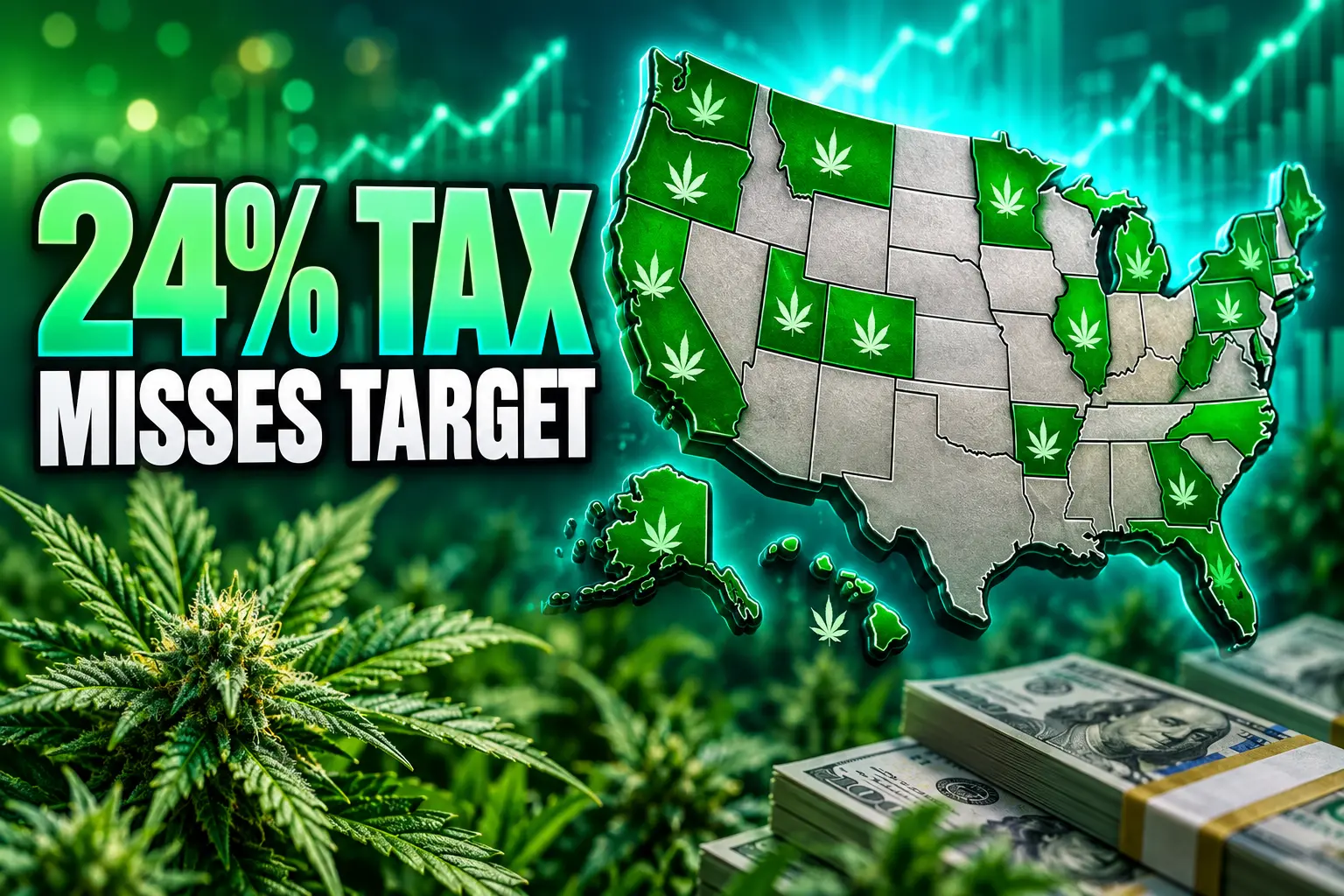
Michigan’s 24% Cannabis Tax Is Missing Its Road Target
Michigan’s 24% cannabis wholesale tax was sold as a $420 million road fix in line with peer states. Early collections and stacked rates tell a harder story.

Michigan’s 24% cannabis wholesale tax, sold as a $420 million road fix, had brought in nearly $34 million through April 30, 2026. Governor Gretchen Whitmer signed the levy on October 7, 2025, and it took effect January 1, stacked on the state’s 10% retail excise tax and 6% sales tax.
Two industry lawsuits are still open. No court has paused the tax, and the fight has moved into the governor’s race.
A $34 Million Start on a $420 Million Pitch
The nonpartisan House Fiscal Agency put the new wholesale levy at about $420 million a year when lawmakers attached it to a road package, or about $105 million a quarter. A later consensus score for the fiscal year, which only covers the months after January 1, sat at $315 million. The State Budget Office’s April books showed nearly $34 million collected through April 30, less than a third of one quarter’s $105 million slice of the original pitch.
THE EARLY TAKE
- The haul: Nearly $34 million through April 30, 2026, in State Budget Office figures.
- The annual pitch: About $420 million a year, per the House Fiscal Agency.
- The quarter math: About $105 million, which is $420 million divided by four.
- The fiscal-year score: $315 million in the January 2026 consensus estimate for a partial year.
Treasury told critics it was too soon to grade a tax that had barely started. “It is far too early to draw any conclusions about the revenue it will generate based on first quarter collections,” the department said, calling the Wholesale Marijuana Tax a complex levy and warning against stretching early checks into a full-year forecast.
That caution has a mechanical basis. For tax year 2026, Treasury set good-faith quarterly payments for 2026 on April 20, July 20, and October 20, with a full set of returns due January 20, 2027. It said it would waive penalties and interest on the first three quarters if a business paid at least 75% of what it ultimately owed for each quarter and then filed in full by that January date. The April print is an early cash figure, not a closed-out year.
Robin Schneider, executive director of the Michigan Cannabis Industry Association, which says it represents more than 400 businesses, did not wait for a closed year. “This so-called road funding plan has failed exactly as the cannabis industry said it would,” she said after the first Treasury report landed.
January Sales Hit the Lowest Mark Since 2023
Headset, a cannabis point-of-sale data firm, put January 2026 sales at $226.4 million, down 8.3% from $247.1 million in January 2025 and the weakest month since 2023. January is usually slow, and a cold start did not help. By March, sales had climbed to $255.4 million, and June held at $253.5 million.
Every month of 2026 that Headset published still ran below the same month a year earlier. The firm also showed the slide began before the tax. The market averaged $274 million a month in 2024, then $265 million in 2025, with 9 of 12 months that year already under the prior year.
HEADSET MONTHLY AVERAGES
| Period | Sales | Note |
|---|---|---|
| 2024 monthly average | $274 million | Pre-tax baseline |
| 2025 monthly average | $265 million | 9 of 12 months below 2024 |
| January 2026 | $226.4 million | Down 8.3% from $247.1 million |
| March 2026 | $255.4 million | Rebound from January |
| June 2026 | $253.5 million | Still below 2025 |
| 2026 monthly average | $247 million | Through June |
The tax accelerated a decline that was already under way. It did not invent one. Flower, the main category, averaged $19.26 per unit across 2025 and $20.66 in the first half of 2026, a 7.3% rise, far short of a full 24% pass-through.
Who Owes the 24% When Product Changes Hands?
Revenue Administrative Bulletin 2026-3, approved March 17, 2026, and updated March 24, says the Comprehensive Road Funding Tax Act taxes 24 percent of the wholesale price on adult-use product. The wholesaler, not the store, is on the hook to Treasury. The seller may try to collect from the retailer, but the seller still owes the state even if the invoice later goes bad. The act gives no bad-debt deduction.
THREE TAXABLE MOVES
- First transfer: The tax hits the first sale or other transfer from a licensed grower or processor to a retail licensee.
- Seed-to-sale shops: Microbusinesses that grow, pack, and sell their own product owe the 24% when a retail-ready package is first created, using Treasury’s average wholesale price.
- Medical-to-adult shifts: Product moved from a medical provisioning center into an adult-use retail license is taxed at that transfer.
Tribal marijuana businesses under a live agreement with Treasury and the Cannabis Regulatory Agency are carved out. Medical sales that stay medical are outside this levy, though the 6% sales tax still applies.
That design lands hardest on independent growers. They invoice stores on net-30 or net-60 terms, then owe the 24% when title moves, whether or not the store has paid. Credit got tighter because a wholesaler who fronts the tax for a shop that later folds still remits in full. Headset counted 956 active cultivation licenses, 275 processors, and 835 dispensaries, an oversupplied market in which stores, not growers, held the pricing lever.
Higher Love, an Upper Peninsula operator with 10 shops, laid off about 60 of its 200 workers in December 2025 and cited the coming tax. C3 Industries closed its Webberville grow and let go 62 people. Republican State Rep. Timmy Beson had warned before the vote that “farmers are price takers, not price setters,” and that forcing them to absorb the tax “will destroy small growers.”
Al Williams, president of the Detroit Cannabis Industry Association, called the vote “a gut punch to the industry” and said a lot of people would have to decide “whether this industry is worthwhile.” Mike DiLaura, chief of corporate operations and general counsel at House of Dank, said, “Our industry is not their piggy bank. Our wallets are not their budget overruns.”
Whitmer Called 24% In Line With the Region
Whitmer said she was sympathetic to the load on cannabis firms and then put Michigan next to other legal states.
The 24% actually makes us commensurate with other states in our region. It is not out of line, and it’s not even close to the tobacco tax on tobacco products or taxes on alcohol.
Gretchen Whitmer, Governor of Michigan
The 24% figure is the new wholesale layer only. Adult-use product still faces the 10% retail excise written into the 2018 Michigan Regulation and Taxation of Marihuana Act and the 6% state sales tax. Headset’s legal and accounting notes put the effective wholesale rate closer to 32% once “wholesale price” includes taxes already on the invoice, and the stacked burden at 42% or higher. Simple addition of 24, 10, and 6 already reaches 40% before any compounding.
The Tax Foundation’s survey of state excise rates for 2026 recorded Michigan’s new 24% wholesale tax on top of the 10% retail levy. Colorado taxes 15% at wholesale on average market rate and 15% at retail. Nevada taxes 15% at wholesale on fair market value and 10% at retail. Washington charges 37% at retail. Those cannabis-specific schedules do not include each state’s general sales tax, which the Foundation’s table also leaves off.
CANNABIS EXCISE LAYERS
| State | Wholesale excise | Retail excise | Michigan’s extra layer |
|---|---|---|---|
| Michigan | 24% | 10% | 6% sales tax on top |
| Colorado | 15% on average market rate | 15% | Not the 6% Michigan stack |
| Nevada | 15% on fair market value | 10% | Not the 6% Michigan stack |
| Washington | None in the 2026 survey | 37% | Single retail excise |
Whitmer’s 24% is one line. The register still rings two more. Trackers of adult-use cannabis tax revenue by state already counted Michigan’s 10% excise and 6% sales tax before the road levy existed, and they now list the 24% wholesale tax from January 1, 2026. Cannabis was already sending money to schools, local governments, and transportation under the 2018 act when Lansing added another cut for roads.
Two Lawsuits, Zero Injunctions
Hours after the signing, the Michigan Cannabis Industry Association filed a 22-page complaint in the Court of Claims. The group argued that adding a wholesale tax changed the voter-approved 2018 act, which set a 10% retail excise, and that a change like that needed a three-fourths vote of the Legislature, not the simple majority that passed a budget bill. The House vote was 78-21. The Senate vote was 19-17. Neither chamber hit three-fourths.
Court of Claims Judge Sima G. Patel, on December 8, 2025, denied a preliminary injunction. She found the plaintiffs had not shown they were likely to win on the claim that the 2018 act was the only way to tax regulated marijuana, or that the 24% could be enacted only by a supermajority amendment. She also left a live factual fight over whether the new tax “contravenes the purposes” of the 2018 initiative, so the case did not die.
On January 5, 2026, she denied the state’s reconsideration motion, finding no palpable error and repeating that discovery was needed on how the tax hits the purposes of the 2018 law, including the risk that buyers move to the illicit market. Rose Tantraphol, the association’s spokesperson, called that order a win for voters because the court still saw serious questions. The tax stayed in force the whole time.
THE COURT CALENDAR
- October 7, 2025: Whitmer signs the Comprehensive Road Funding Tax Act.
- October 2025: The Michigan Cannabis Industry Association files the first Court of Claims suit.
- December 8, 2025: Judge Patel denies a preliminary injunction; the January 1 start date holds.
- January 1, 2026: The 24% wholesale tax takes effect.
- January 5, 2026: Patel denies the state’s bid to toss the remaining claim.
- Late March 2026: The association, grower Mitten Distro X LLC, and retailer Refine Michigan Co. file a second suit on tax pyramiding and Michigan’s 6% sales-tax cap.
The second case treats the 24% as behaving like a sales tax stacked on other sales taxes, which the plaintiffs say pushes collections past the constitutional cap. Headset noted both challenges were pending and that no injunction had issued. Operators still have to pay on the quarterly calendar to keep licenses clean with the Cannabis Regulatory Agency.
The Senate Needed 19 Votes to Keep Government Open
The 24% was not a stand-alone cannabis bill. It rode inside a larger budget and road package after House leaders said they would not entertain another continuation budget once the prior one expired on October 8, 2025. Industry groups rallied at the Capitol. The Senate still cleared the tax 19-17, because a no on the tax was, for many members, a no on the whole deal and a path to a shutdown.
That is how a sector that already paid a 10% excise voters wrote in 2018 became the patch for a road hole. An earlier 2025 trial balloon had floated a 32% wholesale rate; the enacted number was 24%. The direction did not change. Cannabis was the line that could pass.
Beson, who voted against loading the cost onto growers, wanted any extra tax at retail, “where prices are set,” and applied evenly, rather than in a way that favors companies that “control every step of their supply chain.” Vertically integrated firms that packed warehouses before January 1 had a short window of untaxed inventory. Independent growers selling into that channel did not.
The Repeal Fight Moves Into the Governor’s Race
A bipartisan group of senators filed repeal language after January’s sales print, before the first quarterly payment was even due. State Sen. Jonathan Lindsey’s repeal bill is one of the measures the association has backed. None of those bills has taken the tax off the books.
In mid-September 2026, the Michigan Cannabis Industry Association endorsed Republican gubernatorial nominee John James, who has pledged to repeal or sharply reduce the wholesale tax. The association called him “the clear choice for the cannabis industry” and said it needed “a leader who will boldly support the cannabis industry and fight for our workers.” Schneider said James had sat with members and taken in the cost of the 2025 levy.
Treasury still wants the next good-faith payment on October 20, 2026. Full 2026 returns remain due January 20, 2027. The Court of Claims still has a live question about the 2018 law’s purposes, and the second pyramiding case is open beside it. The roads package is spending money. The 24% line that was supposed to underwrite a $420 million share of that work is still being measured against a $34 million start.

What Are the Effects of Combining Alcohol and Cannabis? A Canadian Evidence Guide

The Same Day GTI Sought DEA Medicine Status, a Class Action Hit

PharmaCann Closed the Olyphant Grow After the IIPR Handover

The OGeez Triple Infused Gummy Trails Peg’s RSO

Kentucky’s First Processor Unlocked Stores and Shut a Pardon

Sam the Skunkman Left Cannabis a Hidden Gene Pool

The 1,500-Pound U-Haul Load Repeats Daley’s Prison Run
PharmaCann Closed the Olyphant Grow After the IIPR Handover
The Same Day GTI Sought DEA Medicine Status, a Class Action Hit

Aurora Pastilles Grew in Australia After Demand Turned
-
 CANNABIS2 years ago
Sam the Skunkman Left Cannabis a Hidden Gene Pool
-
 MARIJUANA2 years ago
The 1,500-Pound U-Haul Load Repeats Daley’s Prison Run
-
 CANNABIS7 months ago
PharmaCann Closed the Olyphant Grow After the IIPR Handover
-
 LAW6 months ago
The Same Day GTI Sought DEA Medicine Status, a Class Action Hit
-
 MEDICAL2 years ago
Aurora Pastilles Grew in Australia After Demand Turned
-

 CANNABIS1 year ago
Ball Family Farms Bets a License on Hoodbaby’s Seed
-
 CANNABIS10 months ago
Kentucky’s First Processor Unlocked Stores and Shut a Pardon
-

 CANNABIS2 years ago
Asake’s GIRAN Cannabis Line Carries His Label Name