
CANNABIS
Five Leaf Clover Asks $1,695,000 Without Pricing Legalization
Five Leaf Clover in Colome is listed at $1,695,000 on medical sales today, with recreational marijuana off South Dakota’s 2026 ballot.

Dustin Swatzell listed Five Leaf Clover in Colome, S.D., for $1,695,000, a price he said tracks current sales rather than a future recreational market. The 41-year-old lives in Sioux Falls and wants more time with his young daughter than the roughly three-hour drive to Tripp County allows.
The package at 210 E. 4th Street stacks a smoke shop, a state-licensed medical dispensary, and a seasonal fireworks stand in a town of 331 people. He listed the operation in early September and said he is in no rush.
What $1,695,000 Buys at 210 E. 4th Street
Shippy Realty & Auction has the Colome corner on the market through agent Robert Moyer as a single turnkey deal. The listing offers the business, property, and inventory together, and it warns that any transfer of the medical license still has to clear South Dakota law. Financials sit behind an NDA.
WHAT IS ON THE BLOCK
| Piece | What comes with it |
|---|---|
| Five Leaf Clover | Smoke shop and alternative-products retail |
| Five Leaf Clover 4.20 | State-licensed medical cannabis dispensary |
| Boom Boom Fireworks | Seasonal fireworks on the same lot |
| The building | 1,344 square feet, built 2022, 0.4 acre, commercial zoning |
| Ask | $1,695,000 ($1,261 per square foot), including inventory |
A new HVAC system is going in, with central air and forced-air propane, and the shop already runs Flowhub and Square. Swatzell said he paid cash for the building in his second year, which took rent off the monthly ledger. He also said the ask reflects how the books look now, not growth he has not booked and not a change in state law he cannot promise.
“If somebody came in and made me a lowball offer, I’d laugh,” he said. “I’m in no rush.”
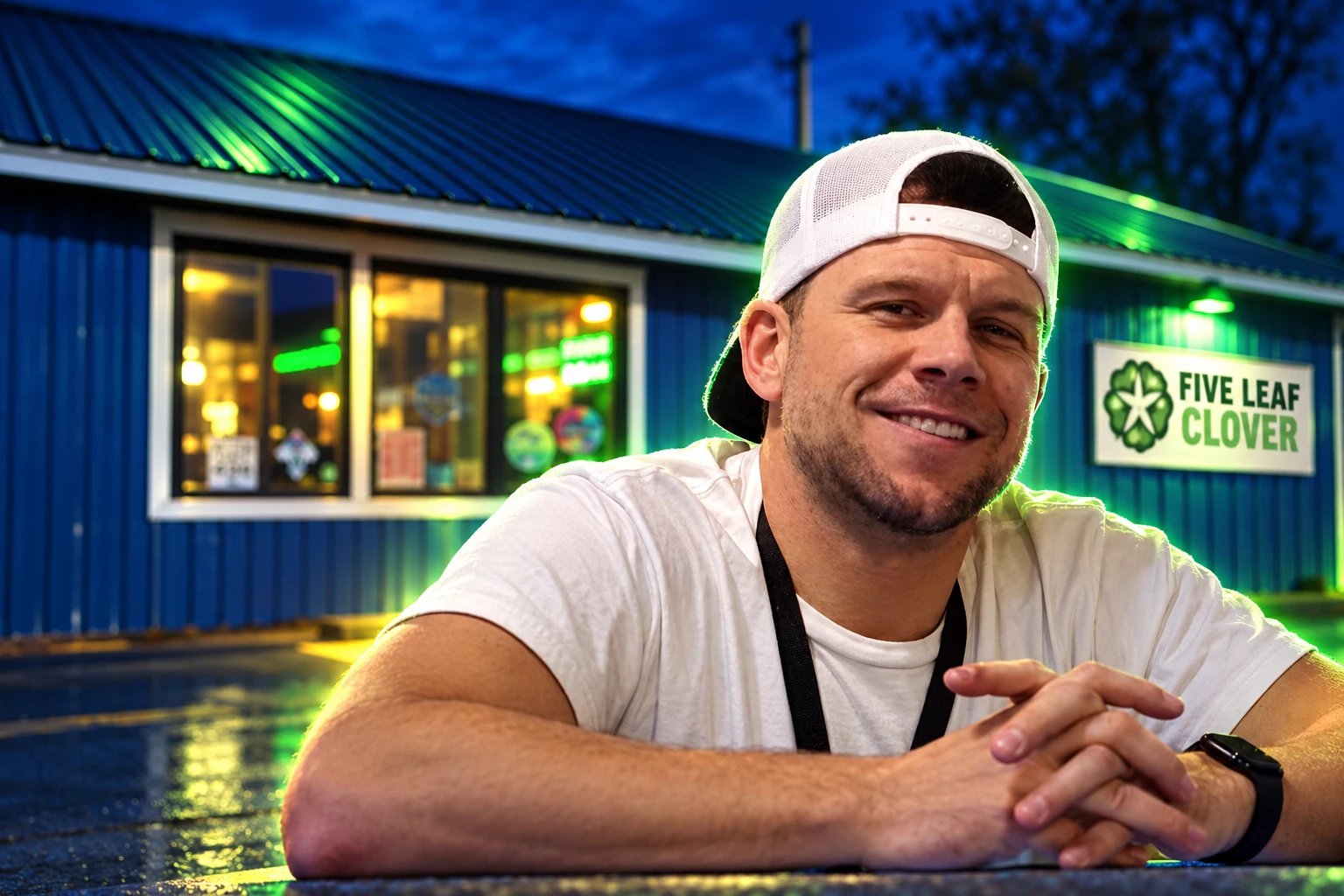
Colome Has 331 Residents and a Highway Corner
The 2020 Census counted 331 people in Colome, in Tripp County, whose county seat is Winner. Swatzell grew up in Washington state, worked a job that ran him between Midland, Texas, and oil fields near Williston, N.D., and then chose a quieter South Dakota town after he decided to change careers. He looked at Winner first and picked the smaller place because he thought customers would want more privacy than a county seat offers.
“Location, location, location,” he said. The shop sits at U.S. Highway 18 and South Dakota Highway 183, among the first businesses travelers see after they cross from Nebraska. The listing calls it the only shop of its kind within about 40 miles and describes the operation as five years strong. Swatzell said the trade area reaches south-central South Dakota and northern Nebraska, including Valentine, Ainsworth, Alliance, Mission, and Rosebud, and that some customers make a round trip of as much as 200 miles.
The welcome was not automatic. He recalled comments such as, “Shame on you, go back to Washington with your weed.” Town board meetings on the shop drew about 50 to 60 people, some against it and some for it, and he said he still sees local officials vote no on permits. He treats that as part of doing business in a small town, and he argues that being an outsider helped patients who did not want to talk about sleep, stress, or anxiety with someone they would see at church.
Two Nearby Dispensaries Closed Within a Year
Swatzell said two dispensaries opened in Winner and Gregory and that both shut within about a year. He credits an established customer base, the owned building, and smoke-shop revenue for keeping Five Leaf Clover standing after those shops left. The Gregory closure is on the public record from the operator’s side.
We just thought we could make sense of it and we ended up hitting a wall with the general population and the amount of patient cards. We were kind of stuck with the limited amount of people and we saw the sales kind of be very stagnant and hit a wall. So we decided to shut Gregory down.
Mike Green, local partner, Greenlight Dispensaries
Greenlight closed that Gregory store in August 2024. Later that fall, Unity Rd. in Hartford, the first licensed medical dispensary off tribal land, set Dec. 7, 2024, as its last day, and at least eight dispensary businesses that held licenses the previous winter no longer did by year’s end. The state’s public list moved from 78 dispensaries to 70 in that stretch, while patient-card counts were still sliding.
The patient side of the ledger has since reversed, which is the part of the bet a buyer actually underwrites. The Department of Health counted 20,040 approved patient cards on Oct. 1, 2026, with 219 approved practitioners, up 3,563 cards from 16,477 a year earlier. September’s program snapshot also listed 631 caregivers. Swatzell said Five Leaf Clover set revenue records in the past year, and he is not selling because the shop is failing.
THE SHOP’S CLOCK
- Before the medical program: Swatzell opens the smoke shop and uses it to introduce CBD and accessories.
- After Initiated Measure 26: He adds Five Leaf Clover 4.20, a licensed dispensary, in the same building.
- Year two: He buys the property in cash. The current 1,344-square-foot building dates to 2022.
- August 2024: Greenlight closes its Gregory dispensary after sales stall.
- Early September 2026: Five Leaf Clover is listed at $1,695,000.
- Oct. 1, 2026: Statewide patient cards reach 20,040.
A new owner still has to keep the license in good standing. The Department of Health charges a $9,000 annual registration fee for a medical cannabis establishment, inspects shops during business hours, and has posted inspection reports for Five Leaf Clover 4.20 in Colome, including a survey dated Oct. 7, 2025.
South Dakota Still Bans Most Cannabis Advertising
Marketing the dispensary is the constraint that made the smoke shop more than a side counter. Swatzell said South Dakota limits how he can promote medical cannabis, including on billboards and other mass media, so he advertises the smoke shop and lets that traffic discover the dispensary. He has looked at billboards in northern Nebraska, where those ads are allowed.
The state rule is stricter than a taste guideline. Administrative Rule 44:90:10:14.01 says that until the Drug Enforcement Administration removes marijuana or cannabis as a Schedule I controlled substance, no establishment may advertise on a sign or billboard except for signs on its own premises.
WHAT THE RULE STILL BLOCKS
- Outdoor ads: Signs and billboards are barred except on the dispensary’s own property.
- Handbills: Shops may not pass flyers in public areas or on publicly owned property.
- Cold outreach: Direct mail, phone, text, or email requires a verified cardholder or establishment and a permanent opt-out.
- Publications: Print ads are barred except inside the shop.
- Broadcast: Radio, television, and other media are barred, with an exception for the shop’s own website and social account.
- Clinics: Ads may not sit in a practitioner’s office or target a clinic’s patients.
Swatzell described those limits as current when he talked about the listing in October, which is why the smoke shop is not a novelty add-on. It is the channel he can legally promote, and it is one of the revenue lines that kept paying when nearby dispensaries did not. Boom Boom Fireworks adds a seasonal till on the same owned lot. A buyer who only wants the medical counter still has to live with a rulebook that treats billboards as a federal problem.
No Recreational Measure on the November Ballot
Swatzell said a recreational market near the Nebraska line could raise the value of the shop, and he still refused to put that chance into the $1,695,000 ask. The public record since 2020 shows why that refusal is more than modesty.
SOUTH DAKOTA’S RECREATIONAL VOTES
| Year | Measure | Result |
|---|---|---|
| 2020 | Constitutional Amendment A | Passed with 54.18% of the vote; a circuit court struck it down on Feb. 8, 2021, and the state Supreme Court upheld that ruling on Nov. 24, 2021 |
| 2022 | Initiated Measure 27 | Defeated |
| 2024 | Initiated Measure 29 | Defeated, 189,916 yes (44%) to 237,228 no (56%) |
| 2026 | Nov. 3 statewide ballot | Four legislative constitutional amendments; none legalizes recreational marijuana |
The 2020 medical measure, Initiated Measure 26, is the law this shop actually operates under. Recreational use remains illegal. Swatzell’s other explanation for a quiet listing is federal: he believes some cannabis-industry buyers are waiting for more clarity, including possible rescheduling.
Part of that wait has already closed for a medical counter. A Justice Department order in April 2026 moved marijuana regulated under state medical marijuana licensing programs, and FDA-approved marijuana products, from Schedule I to Schedule III. A broader DEA proceeding on additional marijuana products, including adult-use, was later stayed; parties have until Oct. 29, 2026, to file briefs on a Government Accountability Office report, with replies due Nov. 5, after which the stay expires by its own terms. Five Leaf Clover cannot sell recreational cannabis under South Dakota law either way. The remaining federal argument is about timing and banking and tax treatment around a medical license, not about a rec counter that does not exist in Colome.
Local Employees Already Run the Store
Swatzell typically goes to Colome two days a week, often Wednesday and Thursday. His work is ordering and books. Local employees run the floor, and he said he pays them well enough that a new owner would not have to stand behind the counter every day. He is willing to walk a buyer through how he has run the place.
That is the operational half of the bet. The shop is already built as an absentee administrative job plus a hired retail crew, which is how a Sioux Falls parent can even put it on the market. It is also why a buyer who does not want to live in a town of 331 can, in his telling, keep the lights on without moving. License approval is still the state’s, and the NDA is still the gate on the numbers.
This was my dream, but now my daughter is my dream.
Dustin Swatzell, owner, Five Leaf Clover
“I have to move along for my family to be there more,” he said. “There’s no reason I would want to get rid of something… I don’t have to on a business note, but I have to for my family.”
Swatzell Will Not Take a Lowball Offer
He said there had not been formal offers in the first few weeks after the early-September listing. He also said he is comfortable running the shop until the right buyer shows up. A $1,695,000 cannabis listing in a town of 331, with the books behind an NDA and the medical license subject to state approval, was never going to trade like a Sioux Falls storefront. He has already decided he will not discount that wait.
If the sale closes, he expects the people to be what he misses. “I’ll miss all the people. I’ll miss the clientele that was created here,” he said. “I’ve never had anybody come into my store without a smile on their face and they’ve never left without a smile on their face.” Until then he is still on the road those two days a week, still ordering product for a medical shop whose statewide patient count is at 20,040, and still asking $1,695,000 for a corner he priced on the business he has, not the ballot measure South Dakota did not put up.
Disclaimer: This article is news reporting on a business listing and on South Dakota’s medical cannabis rules, and it is for information only. It is not an offer to sell the shop, not a valuation, and not legal, tax, or investment advice about cannabis licenses, Schedule III status, or any purchase. Anyone considering a bid should talk with a South Dakota attorney who handles cannabis licensing and with a qualified accountant before acting, and should independently verify the books, the license, and local permits. Asking prices, patient counts, inspection status, and federal scheduling can change after the dates named in the sources above.

Five Leaf Clover Asks $1,695,000 Without Pricing Legalization

What Are the Effects of Combining Alcohol and Cannabis? A Canadian Evidence Guide

The Same Day GTI Sought DEA Medicine Status, a Class Action Hit

PharmaCann Closed the Olyphant Grow After the IIPR Handover

The OGeez Triple Infused Gummy Trails Peg’s RSO

Sam the Skunkman Left Cannabis a Hidden Gene Pool
PharmaCann Closed the Olyphant Grow After the IIPR Handover
The Same Day GTI Sought DEA Medicine Status, a Class Action Hit

Aurora Pastilles Grew in Australia After Demand Turned

Ball Family Farms Bets a License on Hoodbaby’s Seed
-
 CANNABIS2 years ago
Sam the Skunkman Left Cannabis a Hidden Gene Pool
-
 CANNABIS7 months ago
PharmaCann Closed the Olyphant Grow After the IIPR Handover
-
 LAW6 months ago
The Same Day GTI Sought DEA Medicine Status, a Class Action Hit
-
 MEDICAL2 years ago
Aurora Pastilles Grew in Australia After Demand Turned
-
 CANNABIS1 year ago
Ball Family Farms Bets a License on Hoodbaby’s Seed
-
 MARIJUANA2 years ago
The 1,500-Pound U-Haul Load Repeats Daley’s Prison Run
-

 HEMP11 months ago
Mace Hemp Repeal Stalls While the Ban Clock Moves
-

 CANNABIS10 months ago
Kentucky’s First Processor Unlocked Stores and Shut a Pardon