
CANNABIS
Michigan Keeps Giving Out Cannabis Lockboxes After Record Child Exposures
Free marijuana lockboxes keep going out across Michigan after 387 child cannabis cases, as a $3 million grant buys boxes instead of smaller packs.

Michigan’s poison center logged 387 cannabis exposures in children under 6 in 2024, a state record, two years after counties started handing out free marijuana lockboxes. The Barry-Eaton District Health Department ran a no-questions drive-through in Charlotte on June 22, 2024, paid with a state cannabis grant.
Those Saturday lines did not stop at the parking lot. They became how Michigan spends a $3 million education fund, while a licensed gummy pack can still hold 200 mg of THC.
A Drive-Through in Charlotte Turned Into Year-Round Boxes
On June 22, 2024, Eaton County residents could pull up to 1033 Health Care Dr. in Charlotte between 11 a.m. and 2 p.m. and take a lockbox. Staff collected no names. They asked no questions. State employees were barred from the pile. Boxes went first come, first served.
The same Saturday, the Barry County Substance Abuse Task Force ran its own giveaway from 10 a.m. to 1 p.m. at 500 Barfield Dr. in Hastings. Both events sat on Marihuana Operation and Oversight Grants from the Cannabis Regulatory Agency inside the Department of Licensing and Regulatory Affairs. The health department’s drive-through marijuana lockbox giveaway cited a Pediatrics study that found just over 200 reported U.S. cases of kids under 6 eating cannabis edibles in 2017, then 3,054 cases in 2021, a 1,375% jump.
Barry-Eaton had already been in this business. In June 2021 the department handed out three-digit combination boxes at its Eaton County clinic, one per household, with the same no-questions rule. The 2024 Saturday was a louder version of a tool the district had used for years.
FROM ONE SATURDAY TO A STANDING PROGRAM
- June 2021: Barry-Eaton begins handing out free three-digit marijuana lockboxes at its Eaton County clinic.
- June 22, 2024: Eaton County runs the Charlotte drive-through; Barry County runs a parallel giveaway in Hastings.
- 2025 grant year: leftover Eaton boxes move to dispensaries, libraries, and Great Start “Baby Bags”; Barry distributes 219 boxes.
- June 21, 2025: Barry hands out 66 lockboxes at a harm-reduction event.
- July 31, 2025: Barry hands out 76 more.
- March 2026: Barry-Eaton tells Eaton County it is still distributing lockboxes under the next grant.
- February 19, 2026: Mecosta County approves about 250 boxes for EMS and Safe Sleep visits.
Eaton’s 2025 write-up to the state said the drive-through worked, then local dispensaries offered to move the rest. Remaining boxes went to Eaton County dispensaries, public libraries, and the Eaton Great Start Collaborative, which slipped them into Baby Bags for new families. Partners asked for more as soon as a delivery landed, and they said so when the stock ran out.
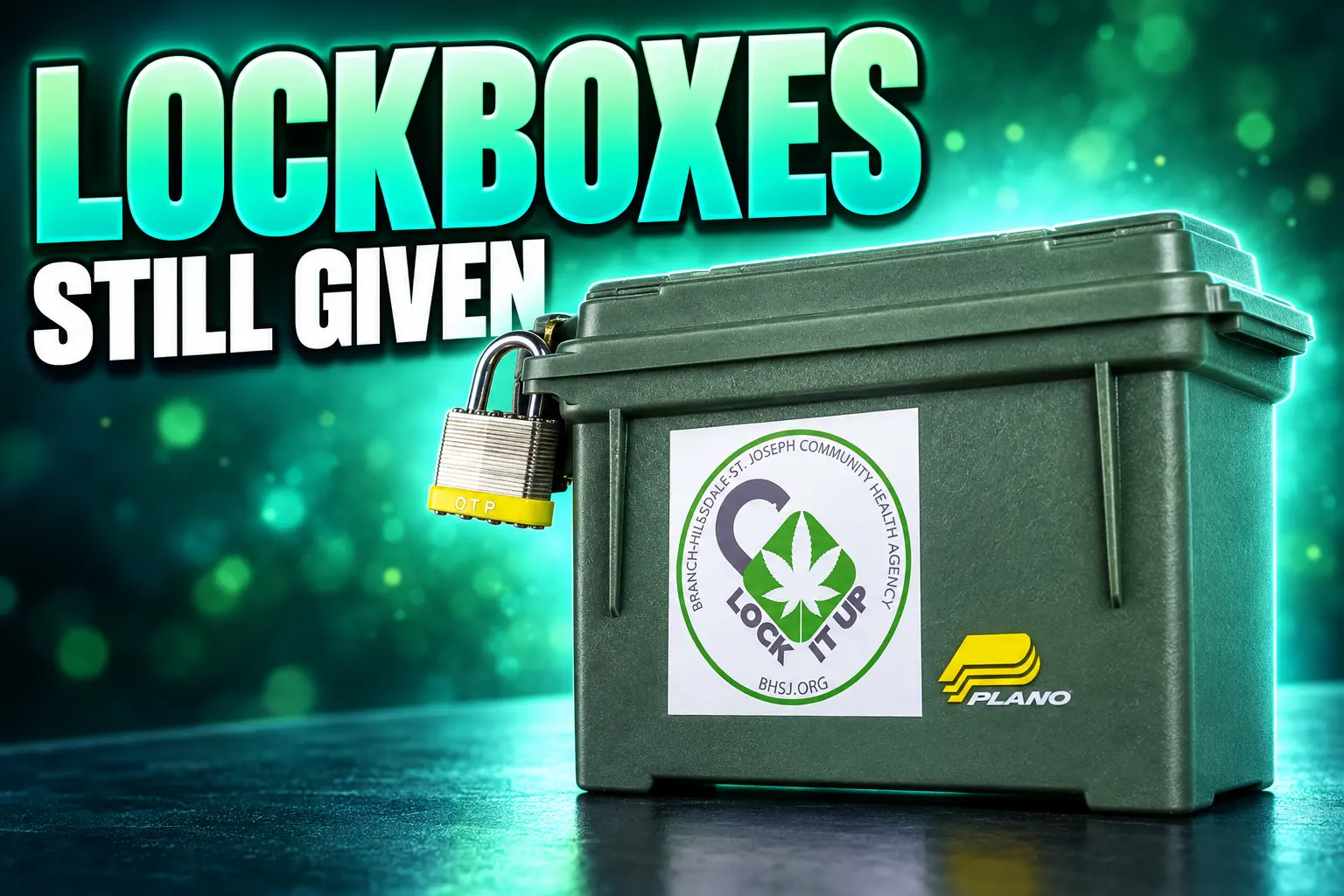
$3 Million a Year Buys Lockboxes Across 53 Counties
The Michigan Legislature has kept the Marihuana Operation and Oversight Grants at $3 million a year for all 83 counties. The money may fund education and outreach on medical and adult-use cannabis. It may not fund law enforcement. Shares are based on medical-registry cards in each county, so a Saturday in Charlotte is a small slice of a statewide hardware run.
In 2025, 53 county agencies applied. They requested $2,475,010 and, according to final reports from 53 counties, spent $2,254,668.61. Unused dollars stay in the Marihuana Regulation Fund. Eaton spent $36,485.71 of a $36,832 award on staff time, a public campaign, a marijuana module in the Barry-Eaton Behavioral Risk Factor Survey, and lockboxes. Barry spent $22,181.56 of $22,198 and moved 219 lockboxes, every one it bought.
WHERE 2025 GRANT HARDWARE LANDED
| County | FY2025 spent | Storage gear purchased |
|---|---|---|
| Eaton | $36,485.71 | Drive-through lockboxes; leftovers to dispensaries, libraries, Baby Bags |
| Barry | $22,181.56 | 219 lockboxes, all distributed |
| Antrim | $17,263.78 | 266 lockboxes (165 planned) |
| Calhoun | $25,490.49 | 6,000 locking bags |
| Genesee | $85,459.80 | 1,450 lock bags and 600 lockboxes |
Calhoun County Public Health bought 6,000 locking bags and logged 787 people who took a bag or a box with education cards. Genesee ordered 1,450 lock bags for homes with underage children and 600 lockboxes aimed at school parents, and staff showed up at 19 outreach events. Benzie, working through cannabis shops, had moved more than 390 lock bags by August 31, 2025. Antrim found a sale and bought 266 boxes instead of 165, then put them in clinics, the Maternal Infant Health Program, and two Mancelona dispensaries.
The 2026 round uses the same $3 million pot on a smaller medical-card base, 25,575 cards against 36,490 the year before. Eaton County’s $41,056 grant share is posted beside Barry’s $24,282. Mecosta County’s board, on February 19, 2026, accepted $3,988 to buy about 250 boxes for EMS crews to carry on patient visits and Safe Sleep calls. Counties owed a final 2026 spending report by September 1, 2026.
Michigan’s Poison Center Logged 387 Child Cases in 2024
The Michigan Poison & Drug Information Center counted 387 reports of children under 6 exposed to or ingesting cannabis in 2024, the highest year in its files. Most of those kids recovered. The same year’s data still show 105 hospital stays and 23 critical-care cases. Over the prior five years the center took about 1,500 under-6 reports, with more than 400 hospital stays and more than 100 critical-care cases. The reported rate doubled in the five years after adult-use sales began in December 2019. Medical cannabis had been legal since 2008.
MICHIGAN’S 2024 CHILD CANNABIS CALLS
- Record year: 387 reports in children under 6, the state’s high mark.
- Hospital care: 105 children admitted, 23 of them to critical care.
- Five-year load: about 1,500 under-6 reports, more than 400 admissions, more than 100 critical-care cases.
- National edible file: 9,667 delta-9 THC and 2,169 hemp-derived edible cases in children 5 and under in 2023 to 2024, 11,836 in all, with no deaths in that National Poison Data System set.
Dr. Meredith Sharp, a pediatric hospitalist at Henry Ford St. John Hospital in Detroit, said her emergency department sees multiple cannabis ingestions in kids each month. “A lot of people just don’t even realize that cannabis can do this to little kids,” she said. “The way they process things is different. They’re much smaller. So a dose that you would normally give to an adult could be really dangerous for a kid.”
Dr. Erica Michiels, an emergency physician and chair of pediatrics at Helen DeVos Children’s Hospital in Grand Rapids, described a run of toddlers who arrived altered, with parents saying they could not wake them. Those workups often include CT scans or spinal taps to rule out bleeding or meningitis, because families rarely walk in and volunteer that a child ate a pack of gummies. Lethargy, confusion, poor coordination, nausea, and vomiting are the usual signs. Slow heart rate, low blood pressure, seizures, and trouble breathing show up in the worse cases.
A Journal of Pediatrics review of 2023 to 2024 poison-center files found hemp-derived cannabinoid edibles, the ones sold outside licensed cannabis shops, tied to higher rates of respiratory depression, low blood pressure, and critical-care admission than delta-9 THC edibles. Monthly delta-9 cases drifted down across those two years. Hemp-derived cases drifted up.
Why Licensed Gummies Still Carry 200 mg of THC
Michigan already requires child-resistant packaging and bars licensed retailers from selling edibles that look like candy. A Cannabis Regulatory Agency limit also caps a single marijuana-gummy container at 200 mg of THC. That is the legal ceiling inside the licensed market, and it is four times the package cap medical toxicologists set in late 2025.
The American College of Medical Toxicology, in a November 13, 2025 position statement, called for opaque child-resistant packs, no child-appealing shapes or colors, a pictorial warning, the poison-center number, and labeled THC. The panel of 18 voting clinicians also set 5 mg portions and 50 mg packs. A 50 mg pack, they argued, would hold a 10 kg toddler, about 1 to 2 years old, to 5 mg/kg if the child ate the whole thing. In one emergency-department series, kids with severe toxicity had swallowed a median 5.4 mg/kg of THC, and almost every case of bradycardia, unresponsiveness, respiratory failure, intubation, or vasopressors involved more than 6 mg/kg.
WHAT TOXICOLOGISTS WANT ON THE PACKAGE
- Look and color: Opaque, child-resistant, not shaped or colored like candy or toys.
- Portion: 5 mg of THC per serving, including a single 5 mg cannabis drink.
- Whole pack: 50 mg of THC total, so one emptied bag is less likely to crash a toddler.
- Label: Pictorial warning, poison-center number, and THC amount for the adult who has to call.
- Other intoxicants: No caffeine, ethanol, delta-8, or delta-10 riding along; those analogs should face the same pack rules as cannabis.
The county grant cannot buy any of that. Statute ties the $3 million to education and outreach. Counties can print flyers, rent billboards, buy lock bags, and staff a drive-through. They cannot rewrite the 200 mg container rule, and they cannot spend the grant on raids at unlicensed shops. Hardware is what the money is allowed to become.
Copycat Candy Still Reaches T-Ball Games and Classrooms
Licensed stores are not where a lot of the candy-look product lives. Detroit’s Office of Cannabis Affairs has flagged gummies dressed as Skittles, Nerds rope, Jolly Ranchers, Sour Patch Kids, and Starburst, the kind of bags that show up in school letters and police photos. Kim James, the office’s director, said that look is the tell. “When you see something like that, you know it’s illegal, because that’s not sanctioned by the state.”
Her staff bought a strawberry-banana “Indica Clusters” bag at a liquor store near city hall. Six gummies, 600 mg of THC, 400 mg over the licensed 200 mg container cap. Hemp processors after the 2018 farm bill have also been converting industrial hemp into delta-8 and delta-10 products that sit outside the Cannabis Regulatory Agency’s store rules and still intoxicate. Those are the same hemp-derived edibles that clustered in the worse arm of the 2023 to 2024 national pediatric file.
Brandon and Sarah Reinkensmeyer do not keep cannabis in their Birmingham home. In 2025 their 8-year-old, Olivia, ate gummies from a bag at her brother’s T-ball game in Troy, split them so nobody felt left out, then crashed into a hospital stay with low oxygen and slow breathing. A parent later pulled an empty bag from the trash. Brandon said it looked like Sour Patch Kids. “How in the heck is this even legal in the state of Michigan?” he asked. It is not, on the licensed side. The bag still reached a picnic blanket.
On April 30, 2026, the Michigan Poison & Drug Information Center warned after two Detroit elementary school students were hospitalized over suspected THC edibles. Dr. Vohra at the center put the packaging problem in one line.
Even small amounts of THC can have serious effects on children. These products are often packaged in ways that make them appealing and easily mistaken for regular treats, which increases the risk of accidental ingestion.
Dr. Vohra, Michigan Poison & Drug Information Center
The center’s number is 1-800-222-1222. That is also the number ACMT wants printed on the pack. Lockboxes never enter that call. The dose already went in.
Toxicologists Want 5 mg Servings and 50 mg Packs
Barry-Eaton is still in the box business. In March 2026 the department told Eaton County’s Public Works and Human Services Committee it remains the county’s subcontractor on the medical-marijuana grant, still hands out lockboxes, and still talks to middle schoolers, high schoolers, and parents about storage and use. Eaton’s 2026 award is $41,056. Demand in 2025 had already outrun supply; partners asked for more boxes on the spot and complained when a delivery was gone.
A lockbox is a real tool in a house where cannabis is legal and a toddler can open a pantry. The 2021 clinic pile, the 2024 Charlotte drive-through, Barry’s 219 boxes, Calhoun’s 6,000 bags, and Mecosta’s EMS kit all treat the same last step: keep the product behind a code. They do not change what a child swallows after the latch is left open, or after a bag that looks like candy leaves a T-ball field, a liquor store, or a desk at school.
Counties will keep buying the boxes because that is what the grant is written to fund. The 387 calls in 2024 are what the boxes were supposed to shrink. The pack on the shelf is still allowed to hold 200 mg, and the bags that do not follow the rules at all keep looking like candy.
Disclaimer: This article is news reporting on county cannabis-education grants and published poison-center figures, and it is for information only. It is not medical advice, a storage protocol, or a guide to treating a child who may have swallowed a cannabis product. Readers who need care or a home-safety plan should talk with a pediatrician, a pharmacist, or the poison center before they act. Counts, grant awards, and product rules match the agency reports and clinical statements cited here and can change as new files are posted.

What Are the Effects of Combining Alcohol and Cannabis? A Canadian Evidence Guide

The Same Day GTI Sought DEA Medicine Status, a Class Action Hit

PharmaCann Closed the Olyphant Grow After the IIPR Handover

The OGeez Triple Infused Gummy Trails Peg’s RSO

Kentucky’s First Processor Unlocked Stores and Shut a Pardon

Sam the Skunkman Left Cannabis a Hidden Gene Pool
The Same Day GTI Sought DEA Medicine Status, a Class Action Hit

The 1,500-Pound U-Haul Load Repeats Daley’s Prison Run
PharmaCann Closed the Olyphant Grow After the IIPR Handover

Aurora Pastilles Grew in Australia After Demand Turned
-
 CANNABIS2 years ago
Sam the Skunkman Left Cannabis a Hidden Gene Pool
-
 LAW6 months ago
The Same Day GTI Sought DEA Medicine Status, a Class Action Hit
-
 MARIJUANA2 years ago
The 1,500-Pound U-Haul Load Repeats Daley’s Prison Run
-
 CANNABIS7 months ago
PharmaCann Closed the Olyphant Grow After the IIPR Handover
-
 MEDICAL2 years ago
Aurora Pastilles Grew in Australia After Demand Turned
-

 CANNABIS1 year ago
Ball Family Farms Bets a License on Hoodbaby’s Seed
-
 CANNABIS10 months ago
Kentucky’s First Processor Unlocked Stores and Shut a Pardon
-

 CANNABIS2 years ago
Asake’s GIRAN Cannabis Line Carries His Label Name