
CANNABIS
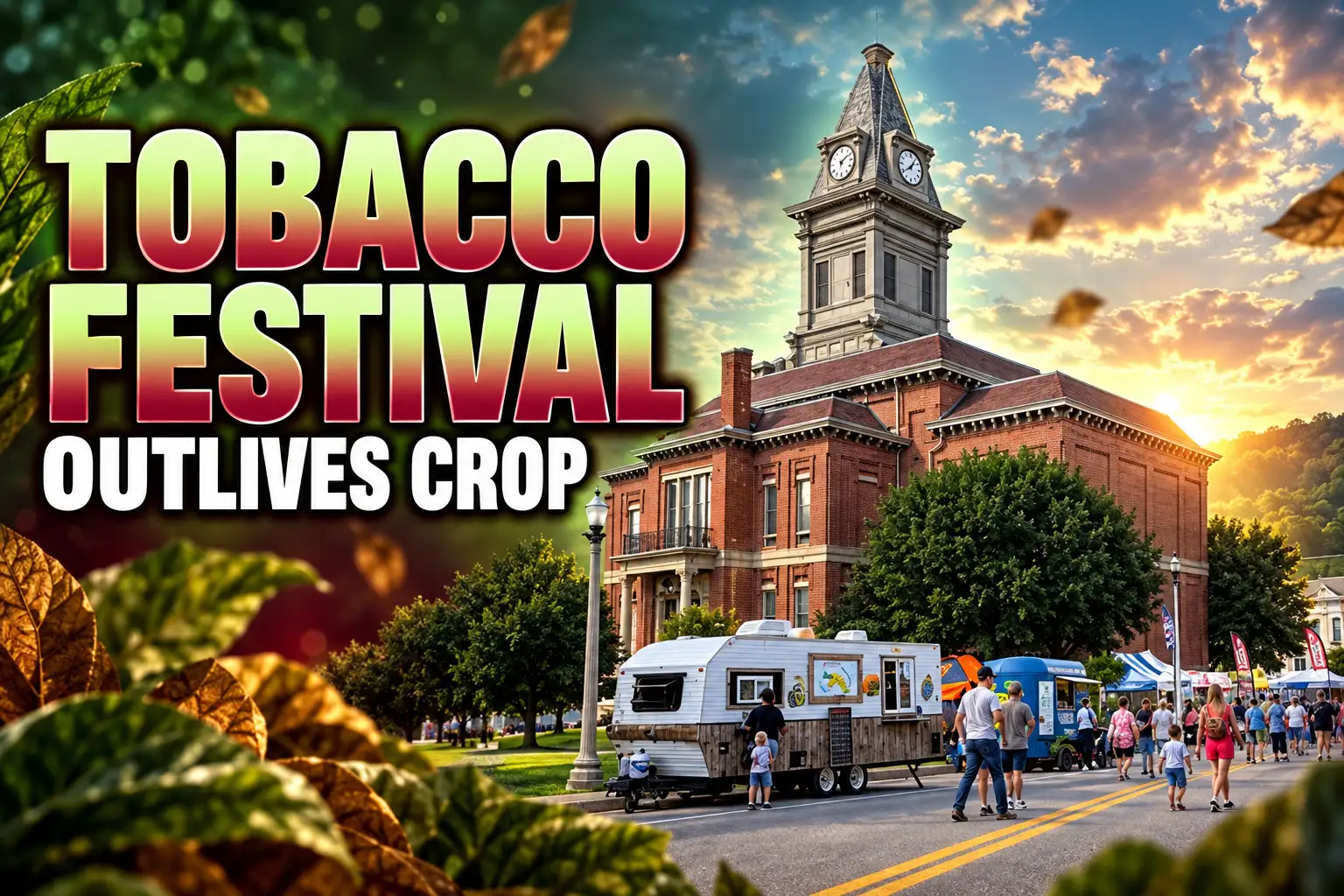
The Elliott County Tobacco Festival Outlived Its Namesake Crop
Sandy Hook marked 50 years of a Tobacco Festival after Kentucky farms fell to 984 and a cannabis dispensary opened in nearby Ashland.

Sandy Hook marked 50 years of the Elliott County Tobacco Festival on Aug. 30 and 31, 2024, in a town of about 628 people. Dewey Smith, the festival’s vice president, called the weekend the county’s family reunion, and the bill ran on Keith Whitley covers, quilts, and a parade that kept coming back after the rain.
Two years later the word on the banner is still tobacco. The crop that paid for those weekends has moved west, shrunk to a contract leftover, and watched a licensed cannabis shop open in Ashland, 46 miles from downtown Sandy Hook.
Rain Could Not Empty Downtown Sandy Hook
The festival is staged the weekend before Labor Day in downtown Sandy Hook, the Elliott County seat. About 7,300 people live in the county. A quarter of them, 25.1 percent, fall below the poverty line, and the median household income sits at $45,776.
Smith watched the crowd duck the showers on Saturday and walk right back onto the street. He said that return was the point of the booking.
We like to call this our family reunion. We see people that come in this time of year that people won’t see again until next year.
Dewey Smith, vice president, Elliott County Tobacco Festival
He added that he loved the sight “because it shows dedication that people want to be here,” and that the lineup, the food booths, and the local sponsors had done their job. Janet Holland, who sews quilts from scratch and had worked the festival for four years, said the draw was the same people. “They are the kind that are sincere, and they support everything that is home,” she said.
SATURDAY’S STAGE IN SANDY HOOK
- Corey Hedger: Opened the 50th-year bill on the downtown stage.
- Hannah Wheeler: Local-circuit country set between the food booths and the raffles.
- Caden Wilson: Louisiana singer who had never been to Sandy Hook and came for Keith Whitley.
- Moonlight Mile: Mid-bill band on the same Saturday board.
- Wes Shipp: Kentucky country act who posted that he was playing the festival that night.
- Whey Jennings: Closed the listed Saturday order with Shipp.
Wilson told the crowd his guitar started with Whitley. “Him and all of them was what I listened to and that’s what I grew up on,” he said. “When I finally decided to pick up the guitar I said, ‘Well, I love Keith Whitley so why not play some Keith Whitley.’” The town felt like home even though he had not met anyone. “Everybody here has been so nice and offered me food all kinds of stuff, it has been a treat.”
Smith closed the 50th by saying the weekend had “grown and flourished,” and that organizers were already looking at the next year. The festival’s Facebook page was still posting in late 2025. The county’s 2026 events calendar for Elliott County leads with Bridge Day, the July 4 downtown show, and the Christmas Jubilee. The Tobacco Festival is not on that featured list.
How Many Tobacco Farms Remain in Kentucky?
Will Snell, extension professor in the University of Kentucky Department of Agricultural Economics, has spent two decades tracking the same collapse. The 2022 Census of Agriculture, which he parsed in February 2024, counted 984 Kentucky farms still growing tobacco. That was down from 2,618 farms in 2017 and 29,237 in 2002, a 97 percent drop in 20 years, and down from nearly 60,000 farms in the early 1990s.
Those 984 farms were 33 percent of the 2,987 tobacco farms left in the United States. The average Kentucky tobacco farm had grown to 44.9 acres, up from 3.8 acres in 2002. Fifteen percent of the farms planted more than 100 acres. Forty-seven percent still planted fewer than 15. Christian County led the state with 77 farms. Not one Kentucky county added tobacco farms between 2017 and 2022.
KENTUCKY TOBACCO, THEN AND NOW
| Measure | Early 1990s | 2002 | 2022 census | 2025 NASS |
|---|---|---|---|---|
| Farms growing tobacco | nearly 60,000 | 29,237 | 984 | heading under 700 by 2027, per Snell |
| Value of the crop | more than $900 million | – | $225 million | $175.7 million |
| Harvested acres | – | – | – | 29,400 |
| Pounds produced | – | – | – | 65,995,000 |
The 2022 crop was worth $225 million, against a 1990s peak Snell now puts at more than $900 million. USDA’s 29,400 harvested tobacco acres in 2025 yielded 65,995,000 pounds at $2.663 a pound, a crop worth $175,725,000. That is the official state overview sitting in the Quick Stats file, and it is smaller than the 2022 census value.
In his July 31, 2026, outlook, Snell wrote that he still hears the same line from people who drive the old burley counties: they cross several counties and never see a tobacco crop. He expects the next census, due in 2027, to find fewer than 700 farms by 2027.
The Banner Still Says Tobacco
Elliott County was already on the list of eastern counties that had lost 75 percent or more of their tobacco farms in the decade after the 2004 buyout. The federal quota system, in place since 1938, ended under the Tobacco Transition Payment Program. Ten-year checks ran through 2014. After that, leaf moved on contracts, and the small eastern patches that had funded a lot of family years did not survive the labor bill.
What is left of Kentucky tobacco is not a museum crop. The state still grows 85 to 90 percent of U.S. burley, Snell wrote, and the United States still cuts a burley crop around 50 million pounds. That is a tenth of the 500 million-pound crops of the 1990s, when America held 30 to 40 percent of world burley. Africa now holds more than 40 percent. The U.S. share is under 5 percent. Brazil grows more than twice the U.S. burley crop in a normal year.
The geography flipped with the contracts. Central Kentucky and the Bluegrass once dominated. Snell says most of the remaining crop sits on larger western farms, often 50 to 100 acres, with the biggest growers over 200. Dark tobacco, the western leaf that feeds snuff, had a better run in the 2000s and 2010s and then hit three years of contract cuts as moist snuff sales fell. Nicotine pouches grew 17 percent over the past 52 weeks, slower than the 30 to 40 percent clip of the years before, and most of that product uses little or no Kentucky leaf.
A festival that still prints “Tobacco” on the poster is not lying about the past. It is no longer describing the fields around Sandy Hook.
Keith Whitley’s Hometown Still Sells the Weekend
County tourism copy does not lead with burley. It leads with Keith Whitley. Jackie Keith Whitley was born July 1, 1954, in Ashland and raised in Sandy Hook. He sang with Ricky Skaggs as a teenager, took the lead with Ralph Stanley’s Clinch Mountain Boys, scored a run of country No. 1s in the late 1980s, and died of alcohol poisoning on May 9, 1989. The Country Music Hall of Fame inducted him in 2022. A statue stands in Elliott County Memory Garden. The tourism site also sells kayaks on the Little Sandy, boats on Grayson Lake, and a Trail Town designation for Sandy Hook.
That is the weekend’s real magnet, and Wilson named it without being asked. He had never set foot in Sandy Hook and still built a set around a man who left the county before the festival was 20 years old. Outside eastern Kentucky, a “tobacco festival” now reads to a lot of people as a leftover name. Inside the county it still means the one weekend the parking fills and the bands play for people who grew up here.
Smith’s “family reunion” line is doing the economic work the crop no longer does. Holland’s quilts, the raffle table, and a Saturday bill that can pull Whey Jennings and a Whitley disciple from Louisiana are the harvest now. The county did not keep the plant. It kept the date.
Ashland Opened a Cannabis Dispensary in May
Gov. Andy Beshear signed Kentucky’s medical cannabis law on March 31, 2023. Legal use began Jan. 1, 2025. The first sales landed in December 2025. The Office of Medical Cannabis has issued 48 dispensary licenses. On the Aug. 28, 2026, open list, 24 shops were serving patients, from Richmond and Lexington to Paducah and Corbin.
One of them is in Ashland. Z3 Medicinal Investments, doing business as Speakeasy Dispensary, opened at 3508 Winchester Ave. on May 7, 2026. The state’s open dispensary list includes Ashland among those 24. That is the hospital town where Whitley was born, 46 miles from the festival street. On June 2, 2026, Beshear said more than 23,700 Kentuckians had been approved for medical cannabis cards.
WHAT KENTUCKY MEDICAL CANNABIS ALLOWS
- The shops: Only office-licensed dispensaries may sell, and home grows are banned.
- The products: Edibles, oils, tinctures, vapes, and raw plant material are legal; vapes are limited to buyers over 21.
- The smoke rule: Raw plant may not be smoked, and packages must say it is not intended for smoking.
- The conditions: Cancer, chronic pain, epilepsy, multiple sclerosis, PTSD, and a longer list clarified by executive order on June 2, 2026.
Hemp was supposed to be the easy swap for tobacco growers after the 2018 farm bill, because both crops start as transplants and both ask for careful handling. CBD prices then fell hard, and the 2026 General Assembly closed without passing the hemp bills growers and processors had watched. Medical cannabis, with 48 licensed storefronts and a ban on homegrown plants, is a regulated product line, not a new fencerow crop for Elliott County. No dispensary on the open list is in Sandy Hook.
Other Counties Keep the Tobacco Weekend
Elliott is not the last Kentucky county that still prints the word. Carroll County scheduled its Tobacco Festival for Sept. 25 and 26, 2026, in downtown Carrollton, with carnival rides, wrestling, music, and a street of food booths. Garrard County staged a Rural Heritage Tobacco Festival in May 2026. The name still works as a civic brand in towns that want a fall crowd, even when the nearest contracted burley is counties away.
That is the split the 50th in Sandy Hook already showed. The music, the vendors, and the parade are a reunion with a crop on the letterhead. Carrollton’s dates sit on the same calendar as a state that cut 29,400 acres of tobacco in 2025 and licensed 48 cannabis stores. The festivals did not wait for the acreage to recover. They stopped needing it.
Leaf Contracts Moved West With the Buyout
Snell’s 2026 paper is blunt about who is still in. The farms that remain have labor, barns, and a buyer. Everyone else left. U.S. burley exports that once topped 200 million pounds a year now run 10 to 20 million, and they were down 66 percent through May 2026 after a large global crop in 2025. Imports in recent years have run 70 to 90 million pounds, larger than the domestic burley crop. Cigarette sales, which used to fall about 3 percent a year, have been falling closer to 7 percent in 2026 after a stretch near 10 percent. Some companies are testing nicotine extracted from U.S. plants for pouches and heat-not-burn products. Snell treats that as an open question, not a new boom.
THE CROP THAT LEFT THE FESTIVAL
- 1938: Federal tobacco quota assigns production rights to specific farms.
- 2004: The buyout ends the quota system and starts a 10-year payout.
- 2014: The last buyout checks go out and contracts take over.
- 2022: The census counts 984 Kentucky tobacco farms, 33 percent of the U.S. total.
- 2024: Sandy Hook throws the 50th Elliott County Tobacco Festival.
- 2025: Medical cannabis sales begin, and Kentucky harvests 29,400 tobacco acres worth $175.7 million.
- May 7, 2026: Speakeasy Dispensary opens on Winchester Avenue in Ashland.
Despite these declines, the tobacco industry remains a viable economic sector. Today’s tobacco consumers have shifted away from traditional combustible products like cigarettes to other “tobacco” or what is referred today as “nicotine delivery” products such as vaping, heat-not-burn products, and more recently, nicotine pouches, all of which presently contain virtually little or no ingredients derived from Kentucky tobaccos.
Will Snell, extension professor, University of Kentucky, July 31, 2026
Sandy Hook can still fill a street for a reunion with Whitley’s name on the tourism card and tobacco on the banner. The barns that used to justify that banner are in other counties now, and the nearest licensed cannabis shop is in the city where the county’s most famous singer was born.
Disclaimer: This article is news reporting and analysis of a civic festival, published crop statistics, and Kentucky’s medical cannabis program. It is informational only and is not medical advice, legal advice, or a recommendation to buy, grow, or use cannabis, hemp, or tobacco products. Readers who are considering medical cannabis should talk with a licensed Kentucky medical cannabis practitioner and review the Office of Medical Cannabis rules before applying for a card or visiting a dispensary. Farm counts, acreage, prices, shop lists, and cardholder totals come from the cited agencies and may change with later USDA releases, census years, and licensing updates.

What Are the Effects of Combining Alcohol and Cannabis? A Canadian Evidence Guide

The Same Day GTI Sought DEA Medicine Status, a Class Action Hit

PharmaCann Closed the Olyphant Grow After the IIPR Handover

The OGeez Triple Infused Gummy Trails Peg’s RSO

Kentucky’s First Processor Unlocked Stores and Shut a Pardon

Sam the Skunkman Left Cannabis a Hidden Gene Pool
The Same Day GTI Sought DEA Medicine Status, a Class Action Hit

Aurora Pastilles Grew in Australia After Demand Turned

Ball Family Farms Bets a License on Hoodbaby’s Seed

The 1,500-Pound U-Haul Load Repeats Daley’s Prison Run
-
 CANNABIS2 years ago
Sam the Skunkman Left Cannabis a Hidden Gene Pool
-
 LAW6 months ago
The Same Day GTI Sought DEA Medicine Status, a Class Action Hit
-
 MEDICAL2 years ago
Aurora Pastilles Grew in Australia After Demand Turned
-
 CANNABIS1 year ago
Ball Family Farms Bets a License on Hoodbaby’s Seed
-
 MARIJUANA2 years ago
The 1,500-Pound U-Haul Load Repeats Daley’s Prison Run
-
 CANNABIS7 months ago
PharmaCann Closed the Olyphant Grow After the IIPR Handover
-
 CANNABIS10 months ago
Kentucky’s First Processor Unlocked Stores and Shut a Pardon
-

 CANNABIS2 years ago
Asake’s GIRAN Cannabis Line Carries His Label Name