
HEMP
France Banned CBD Edibles While Shop Cannabis Turned Synthetic
France pulled CBD gummies on 15 May 2026 under Novel Food rules, just as OFDT sampling showed more adulterated cannabis, shop synthetics and illicit edibles.

France pulled CBD gummies, dropper oils and hemp sweets from sale on 15 May 2026 under European Novel Food rules. The agriculture ministry pointed to several hundred poisonings tied to CBD foods since 2024, and to a European opinion that still will not clear the ingredient.
The same lab network that tracks street drugs had, in 2025, already found more illicit gummies, surprise THC and synthetic cannabinoids in products sold as CBD.
SINTES Logged More Adulterated Cannabis in 2025
The Observatoire français des drogues et des tendances addictives (OFDT) published Point SINTES n°11 on 11 June 2026. SINTES is the national system that takes street samples when a dose looks wrong, a new powder shows up, or a user reports a bad reaction. OFDT is clear that the system does not map the whole market. It hunts threats.
Collections still jumped. SINTES logged 732 samples in 2023, 742 in 2024 and 1,086 in 2025, after the network added overseas posts and lab capacity, and after the street mix itself got wider. Among samples that failed a conformity check, adulteration rose from 20.2 percent (47 cases) in 2023 and 20.9 percent (49) in 2024 to 33.6 percent (122) in 2025. That share is of the non-conforming pile, not of every bag in France.
Cannabis is the thread that ties the lab note to the shop ban. THC-bearing collections rose from 67 in 2024 to 109 in 2025. Resin and herb still led, but sweets moved in. OFDT’s 2024 and 2025 SINTES collection results split the THC forms it itemised as follows.
THC FORMS SINTES ITEMISED
| Form | 2024 collections | 2025 collections |
|---|---|---|
| Resin | 32 | 44 |
| Herb | 21 | 39 |
| Edibles | 9 | 15 |
| E-liquids | 2 | 5 |
The 2025 edible count is 14 gummy or sweet samples plus one cake. Those rows do not add up to the 67 and 109 THC totals, because a few oils and other forms sit outside the itemised list. Treat the table as the mix OFDT chose to break out, not as a census of every joint in the country.
The 2025 THC batch came with a heavy health file: 41 unexpected effects, 45 adverse events and 21 serious events. The clinical picture OFDT lists matches a high-THC hit, hallucinations, severe anxiety, depersonalisation, fainting, vomiting and psychotic spells. One of those 109 THC samples also held glass microbeads, a cheap way to make a bag weigh more.
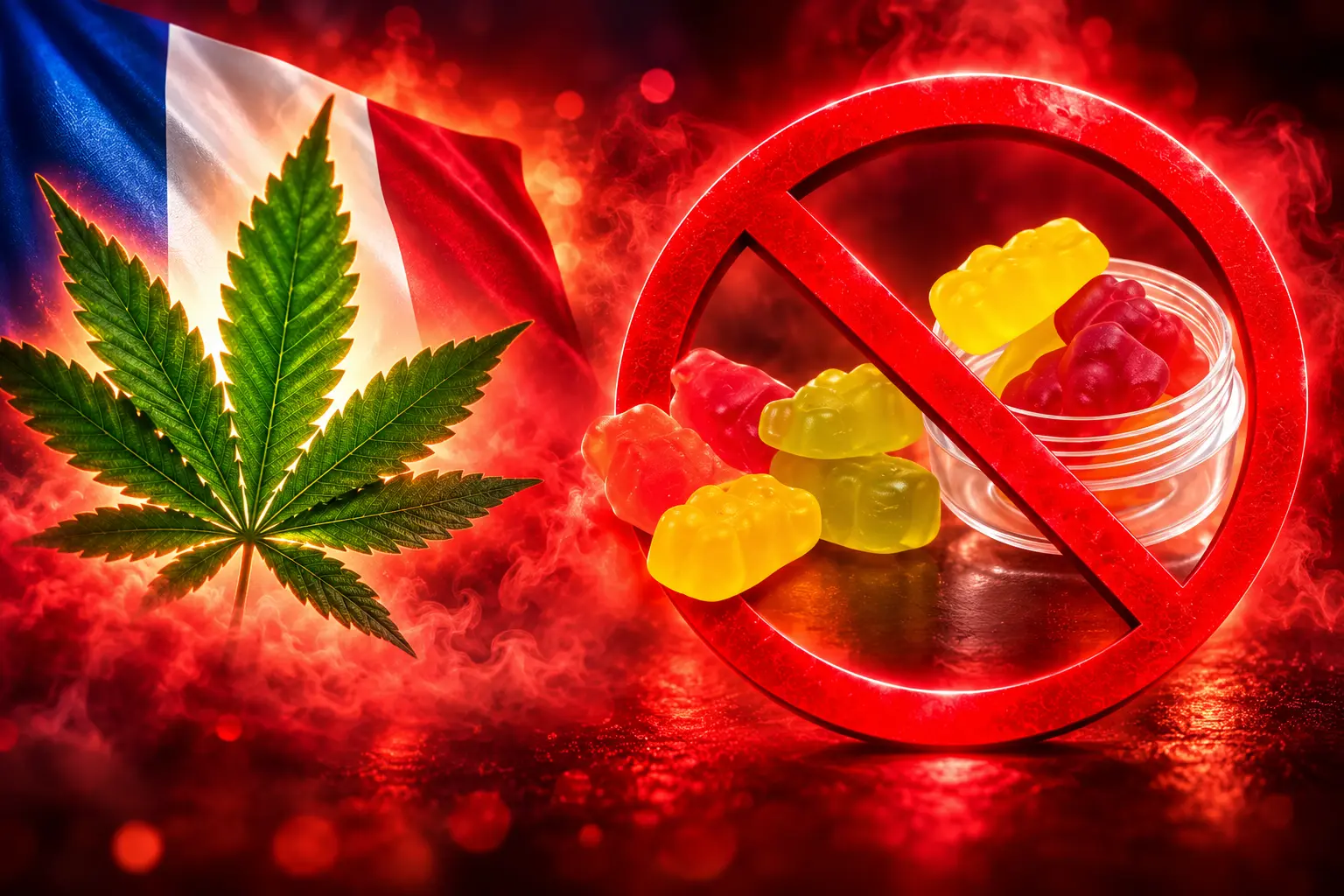
Why the Agriculture Ministry Pulled CBD Gummies
Legal hemp-derived CBD in France must stay at or under 0.3 percent THC. Recreational cannabis is still illegal. OFDT’s 2025 key data put daily cannabis use at 900,000 people, the most-used illegal drug in the country. The edible fight is not about that market on paper. It is about food law.
On 15 April 2026 the Direction générale de l’alimentation (DGAL) told the main hemp and supplement groups, including UPCBD, UIVEC, AFPC, SPC and Synadiet, that 2026 controls would cover every food and supplement that names CBD, THC or any other cannabinoid on the label. From 15 May 2026, shops had to pull those lines with no time to clear stock. On 20 May the agriculture ministry said foods containing CBD must leave the market, because Regulation (EU) 2015/2283 still treats cannabidiol as a novel food whose safety has not been shown.
The European Food Safety Authority, on 9 February 2026, set a provisional safe intake of about 2 mg a day for a 70 kg adult, or 0.0275 milligrams per kilogram. That line applies only to supplement formulas that are at least 98 percent CBD, free of nanoparticles, made by a process judged safe, with genotoxicity ruled out. EFSA would not set a safe intake for anyone under 25, for pregnant or lactating women, or for people on other medicine. It again flagged gaps on the liver and on the endocrine, nervous and reproductive systems, the same holes it named in June 2022.
Hemp seeds, hemp-seed oil and leaves used only for a water infusion stay outside the novel-food net if they are not spiked with cannabinoid extracts. Everything else that is sold to be swallowed and that boasts CBD on the pack is in the control plan. The ministry also pointed to a rise, since 2024, in poisonings after people ate CBD foods, several hundred cases in all, some of them involving other substances mixed into the same product.
Forty Percent of Shop Sales Vanished From the Counter
Specialist shops did not lose a novelty SKU. Industry groups say ingestible CBD, oils, gummies, capsules and the rest, made up about 40 percent of sales in that retail net. Paul Maclean, a representative of the Union des professionnels du CBD, said the DGAL stance was “completely absurd,” and that going after edibles alone “makes absolutely no sense,” because the same plant can still be smoked as flower.
We find this completely absurd.
Paul Maclean, representative, Union des professionnels du CBD
THE SHELF THAT WENT DARK
- Shop hit: UPCBD says the pull reaches more than 2,000 specialist shops.
- Pharmacy hit: Industry figures put CBD on the shelves of 20,000 pharmacies, which now face the same food-law rule as a high-street hemp store.
- Farm backdrop: InterChanvre counts 1,850 industrial-hemp producers on 24,600 hectares, Europe’s largest hemp area and the world’s second after China.
- What stayed a medicine: Epidiolex, the prescription cannabidiol drug, remains a licensed medicine, not a food supplement.
Confédération paysanne called the food-law turn a direct threat to French hemp. Insurers, trade groups add, already treat CBD stock as a “regulated substance,” so a shop’s main asset can sit uninsured while inspectors bag the gummies. Older customers who had used dropper oils to taper painkillers are left to infuse flower at home, a fiddly substitute for a labelled milligram count.
Flower, Resin and Vape Liquids Remain on Sale
The control plan follows the EU definition of food. It does not cover hemp flowers, resins, vape liquids or cosmetics. Private use of a pack bought before 15 May 2026 is not the target. Sale is.
STILL FOR SALE AFTER 15 MAY
- Off the counter: Gummies and candies, sublingual oils sold as supplements, capsules, chocolates, drinks, syrups and infusions made from flower tops.
- Still legal to sell: CBD flower and resin at or under 0.3 percent THC, cosmetic creams and skin oils, e-liquids, pre-rolls, hemp seeds and hemp-seed oil, plus leaves for a plain water infusion.
- Still illegal to sell: Recreational THC flower, resin and edibles above the hemp threshold, as before.
- Closed medical door: New patients have been barred from the medical-cannabis experiment since 27 March 2024, so a dosed ingestible is not waiting at the hospital pharmacy either.
A customer can still buy the plant, grind it and swallow an infusion they make themselves. They cannot buy the gummy that came with a milligram line on the pack. That is the split Maclean called absurd, and it is also the split SINTES had already filled with a different kind of sweet.
CBD Counters Already Sold Synthetic Cannabinoids
The ministry sold the 15 May pull as a consumer-safety step against mislabelled ingestibles. The OFDT note, covering 2024 and 2025, shows the contamination problem sitting in the aisle that remains open. SINTES recorded numerous adulterations with synthetic cannabinoids, most often without the user’s knowledge, in products sold over the counter in CBD shops, tobacco shops and vending machines.
Collections of synthetic or hemisynthetic cannabinoids in products meant to be smoked rose from 47 in 2024 to 106 in 2025. Herb led that pile (18, then 60), then resin (10, then 32), with a few concentrates and sweets on the edge. In all, 69 herb and resin samples that were mostly supposed to hold CBD contained at least one lab-made cannabinoid. The 2025 identifications were not a single mystery molecule. CUMYL-PINACA and EDMB-4en-PINACA each turned up 18 times, with MDMB-PINACA and MDMB-4en-PINACA close behind. Across 2024 and 2025 SINTES named 40 new psychoactive substances, 26 of them in 2025, many of them hemp lookalikes.
Illicit edibles were already in the 2025 bag, 14 gummy collections plus one cake, before DGAL emptied the legal sweet jar. The labelled gummy left the pharmacy. The unlabelled one did not leave the street. French-language web shops were still advertising CBD gummies in late October, five months after the withdrawal. Oil that is illegal to sell here is a short trip away in another EU country. Grey-market sweets filled the gap the shops had to leave.
Enforcement Survived the Emergency Hearing
UPCBD and UIVEC, with Italian hemp group Nazionale Canapa Sativa Italia and several firms, asked the Conseil d’État to freeze the control plan. The court recorded the filing on 12 June 2026. They wanted an emergency stay and, later, a ruling that the plan was unlawful, arguing that the state had spent years working with the sector and then reversed course with no transition.
THE CONTROL PLAN IN COURT
- 15 April 2026: DGAL presents the 2026 national control plan to hemp and supplement groups.
- 15 May 2026: Inspectors begin pulling ingestible CBD from shops, with no stock-clearance window.
- 20 May 2026: The agriculture ministry publishes the withdrawal notice and cites several hundred poisonings.
- 11 June 2026: OFDT releases Point SINTES n°11 on 2024 and 2025 collections.
- 12 June 2026: UPCBD, UIVEC and others file at the Conseil d’État.
- 10 July 2026: The emergency judge rejects the stay in order n° 516668, without ruling on whether the plan is legal.
The 10 July 2026 emergency order found that the urgency test in article L. 521-1 of the administrative justice code was not met. The judge did not examine the legality of the DGAL plan and did not take up the EU-law questions the unions had asked to send to Luxembourg. The order simply rejects the request. A decision on the merits was described as due in autumn 2026. As of late October that ruling had not been published, so the pull remains the working rule.
Guillaume Gontard’s Bill Would License CBD Shops
On 8 October 2026, Green senator Guillaume Gontard and 16 colleagues filed Senate text n° 21, a bill on cannabidiol traceability and shops, sent to the social-affairs committee. UPCBD and the Association française des producteurs de cannabinoïdes back the draft. It would write “raw hemp flowers” into the public-health code, stand up a national lot registry branded as a computerised hemp register, require a shop licence after training on the rules, minors and civil liability, and bar sales to anyone under 18.
Gontard called the food-law turn another blow to a trade that still has no clear statute. The bill does not magically authorise gummies. Novel-food approval still sits in Brussels, and EFSA’s 2 mg line, if it ever becomes a finished authorisation, would force most of the old gummy jar to be reformulated anyway. What the Senate text would do is tag the flower that remains legal, the same flower SINTES keeps finding spiked with CUMYL-PINACA in a vending machine.
Five months after 15 May, the labelled milligram gummy is gone from the French counter. The street sample bag is not. SINTES is still a threat system, not a till receipt, but the 2025 mix it did see, more sweets, more shop-counter synthetics, one bag of glass, is the mix that met the customer after the pharmacy sweet jar was emptied.
Disclaimer: This article is news reporting on French hemp rules, court filings and drug-checking results. It is informational only and is not medical, legal or investment advice, and it is not a guide to buying, making or using cannabis or CBD products. Anyone thinking about CBD, cannabis or a change to prescribed medicine should speak with a licensed physician or pharmacist, and anyone facing a control, a seizure or a shop audit should speak with a qualified lawyer. Figures, case counts and legal statuses reflect the OFDT, ministry, EFSA, court and Senate documents cited here and can change as new samples, rulings or decrees appear.

The Hemp THC Delay Hands Dispensaries the Intoxicating Shelf

Trump’s Medicare CBD Gift Stalls Before the Hemp Ban

Maryland Vets Can Talk CBD Before Federal Hemp Rules Hit

France Banned CBD Edibles While Shop Cannabis Turned Synthetic

A 0.4 mg Cap Threatens Kentucky Full-Spectrum CBD Oil

Kentucky’s First Processor Unlocked Stores and Shut a Pardon

PharmaCann Closed the Olyphant Grow After the IIPR Handover

Numinus Missed Its Filing Date and Lost the TSX

Aurora Pastilles Grew in Australia After Demand Turned

The OGeez Triple Infused Gummy Trails Peg’s RSO
-
 CANNABIS10 months ago
Kentucky’s First Processor Unlocked Stores and Shut a Pardon
-
 CANNABIS8 months ago
PharmaCann Closed the Olyphant Grow After the IIPR Handover
-
 BUSINESS2 years ago
Numinus Missed Its Filing Date and Lost the TSX
-
 MEDICAL2 years ago
Aurora Pastilles Grew in Australia After Demand Turned
-
 NEWS9 months ago
The OGeez Triple Infused Gummy Trails Peg’s RSO
-

 LAW6 months ago
The Same Day GTI Sought DEA Medicine Status, a Class Action Hit
-

 MARIJUANA2 years ago
The 1,500-Pound U-Haul Load Repeats Daley’s Prison Run
-

 CANNABIS2 years ago
Sam the Skunkman Left Cannabis a Hidden Gene Pool