
LAW
Maryland Vets Can Talk CBD Before Federal Hemp Rules Hit
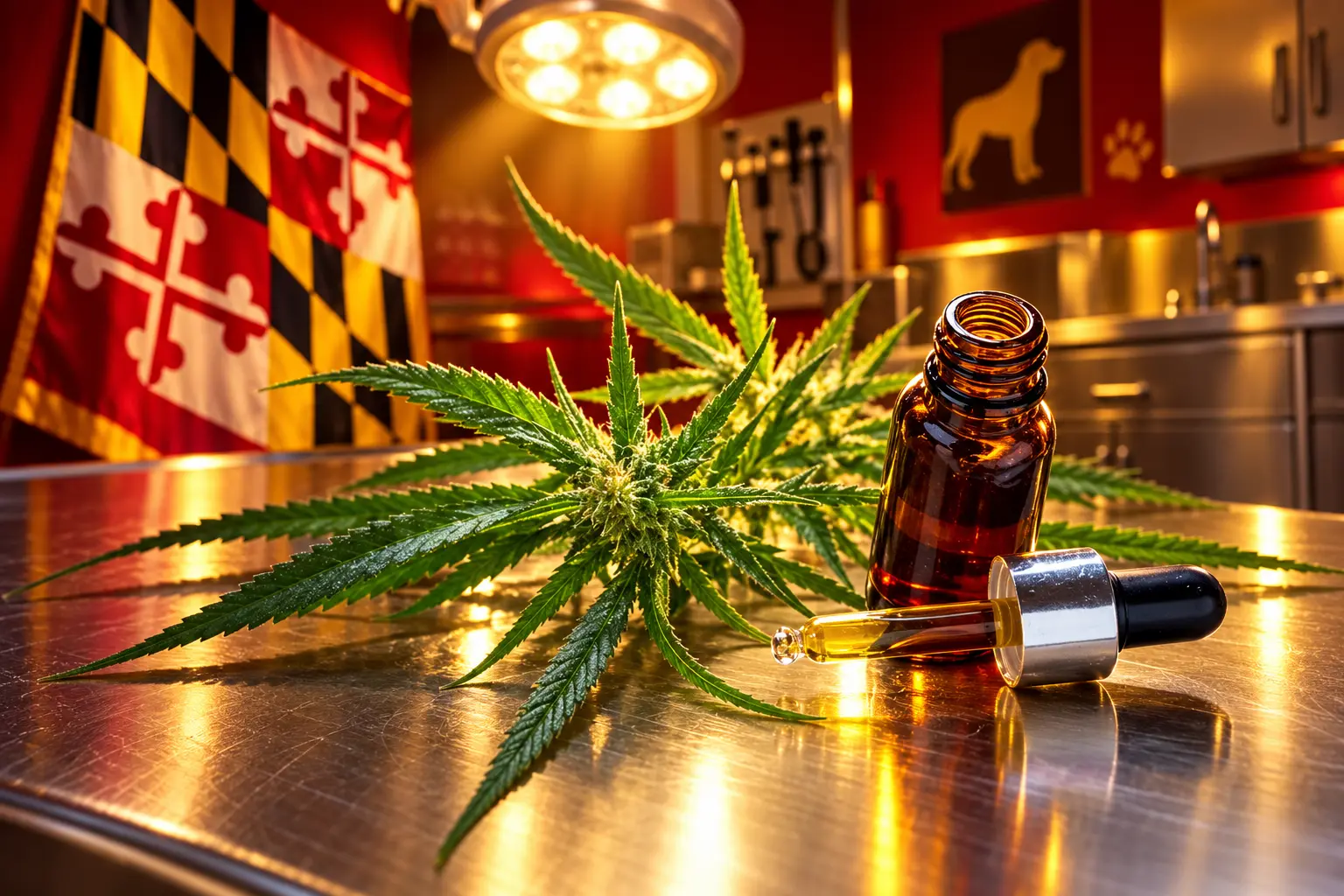
Maryland now shields veterinarians who discuss cannabis or CBD for animals, without letting them prescribe, as a December hemp cap closes in on pet products.

Maryland barred its veterinary board on October 1, 2026, from punishing a veterinarian solely for discussing or recommending cannabis or CBD for an animal. The shield covers talk, including a recommendation for “potential therapeutic effect or health supplementation purposes.”
It does not create a pet cannabis prescription. A federal hemp rewrite due December 11, 2026, also counts total THC in products meant for animals, which is the shelf those exam-room talks are about.
Maryland’s New Shield Covers Conversation Only
House Bill 452, now Chapter 47, was signed by Gov. Wes Moore on April 14, 2026. Senate Bill 54, the companion filed by Sen. Clarence Lam, became Chapter 48 the same day. Both chambers passed the package unanimously.
The new subsection of Agriculture Article §2-310 says the State Board of Veterinary Medical Examiners may not suspend or revoke a license, reprimand or censure a licensee, or place a licensee on probation solely for discussing or recommending cannabis or a product that contains cannabidiol on an animal.
Cannabis in that sentence means Cannabis sativa L. and its extracts with a delta-9 THC concentration greater than 0.3 percent on a dry weight basis. Hemp is carved out of that definition. The second prong, any product that contains CBD, is how hemp CBD oils and chews come under the same shield.
The word “solely” does the limiting work. If the board has another ground, incompetence, cruelty, a drug-law conviction, the new clause does not block the case. The statute is silent on prescribing, dispensing, compounding, and product approval.
A letter about the issue sent by the State Board of Veterinary Medical Examiners a few years ago has given a lot of caution to veterinarians to even talk about whether cannabis might be helpful for an animal.
Sen. Clarence Lam, February 2026 Senate hearing
Lam told the Education, Energy, and the Environment Committee he had heard from veterinarians whose clients had animals with cancer and could not get an answer about cannabis for pain. He called the bill a baseline so vets could answer with evidence-based information. Delegate Michele Guyton carried the House file.
Zero Formal Cases on More Than 3,300 Licenses
The Department of Legislative Services, in the third-reader fiscal note dated March 20, 2026, said the bill would not materially affect state finances. To date, the board had not taken any formal action the bill would prohibit.
That board, inside the Maryland Department of Agriculture, licenses more than 3,300 veterinarians and 600 hospitals, plus more than 950 registered veterinary technicians and about 30 animal-control facilities. The power it lost was one it had not used in a recorded case. The chill Lam described came from a letter, not a docket.
Matthew Weeman, speaking for the Maryland Veterinary Medical Association, told the same Senate committee the bill would reinforce the veterinary-client-patient relationship. He said the topic comes up often in small-animal practice, and that CBD products are already on store shelves. Clients were not waiting for a statute. They were bringing bottles into the room and asking what they did.
THE PATH TO OCTOBER 1
- September 19, 2025: Senate Bill 54 is pre-filed by Sen. Lam.
- January 23, 2026: House Bill 452 by Del. Guyton receives its first reading.
- February 2026: Lam and the Maryland Veterinary Medical Association testify that a board letter had made even a conversation feel risky.
- April 14, 2026: Gov. Wes Moore signs the House and Senate bills as Chapters 47 and 48.
- October 1, 2026: The shield takes effect. Prescribing authority does not change.
Similar legislation had not been introduced in Maryland in the prior three years, the fiscal note said. The first new veterinary-specific cannabis statute in the country since 2022 arrived as a speech rule, not a product rule.
What Maryland Veterinarians Still Cannot Do
A Maryland vet may now discuss or recommend cannabis or a CBD product without that talk, standing alone, costing a license. The vet still cannot treat those products as approved animal drugs, write them as if they were, or rely on federal extra-label rules that apply only to drugs the Food and Drug Administration has already approved.
The FDA has not approved cannabis for any use in animals and says it cannot ensure the safety or effectiveness of products marketed for them. It cautions owners against those products and, in the same answer, tells them to talk with their veterinarian. Until October 1, that federal nudge pointed Maryland clients at clinicians who had been told a board letter made the conversation dangerous.
Extra-label use of an approved human drug in an animal is a separate federal path, and it requires an approved drug. Epidiolex is the one cannabis-derived human drug. Marinol, Syndros, and Cesamet are the three cannabis-related human drugs. None is an animal approval. A hemp CBD oil sold as a chew or tincture is not in that set.
STILL OFF THE TABLE IN MARYLAND
- A prescription: Chapter 47 does not authorize prescribing, dispensing, or compounding cannabis or CBD for an animal.
- An approved animal drug: No FDA-approved, conditionally approved, or indexed animal drug contains CBD.
- A food claim: Adding CBD or THC to animal food sold across state lines is a prohibited act unless the ingredient is an approved additive or GRAS for that use.
- Cover for other charges: Gross negligence, cruelty, incompetence, and drug-law convictions remain grounds for board action.
In April 2025 the FDA Center for Veterinary Medicine sent warning letters to Bailey’s Wellness, Holista, and House of Alchemy over unapproved cannabis-derived pet products. The agency’s January 2025 request for information had already asked veterinarians for adverse-event and drug-interaction experience. The Maryland statute does not answer that federal file.
California Sells Animal Cannabis Under a 1 mg Cap
Maryland is the fifth state to write a veterinary-specific cannabis statute, after California, Michigan, Nevada, and Utah. California went further than a speech shield. Assembly Bill 2215 in 2018 protected discussion. Assembly Bill 1885 in 2022 protected a recommendation, required board guidelines, and barred a veterinarian from dispensing or administering cannabis to an animal patient.
The California Veterinary Medical Board posted those guidelines. The California Department of Cannabis Control then adopted rules that allow manufacture, distribution, and sale of animal cannabis products, limited to edibles, orally consumed concentrates, and topicals. An animal cannabis product may contain no more than one milligram of total THC per package. Flower, vapes, and inhaled concentrates are out.
Maryland wrote none of that. No guidelines. No animal-product standard. No 1 mg cap. No ban on dispensing in the new text, and no grant of dispensing either. A Maryland client who wants a regulated animal cannabis item is looking at a California-style market that Annapolis did not build. A Maryland vet who wants a safe-harbor script is looking at a sentence about talk.
TWO STATE MODELS
| Rule | Maryland (2026) | California |
|---|---|---|
| Board discipline for discussion | Barred if that is the sole basis | Barred, absent negligence or incompetence |
| Board discipline for a recommendation | Barred if that is the sole basis | Barred unless the vet is tied to a cannabis licensee |
| Written board guidelines | Not required | Required and posted |
| Animal cannabis products | Not addressed | Allowed under DCC rules, 1 mg total THC per package |
| Vet dispensing or administering | Not granted | Explicitly prohibited |
Michigan moved in 2020, Nevada in 2021, and Utah in 2022. Then the pipeline went quiet. Maryland’s 2026 bills broke a four-year gap with the narrower of the two models on the table.
The Hemp Rewrite Reaches Pet Products in December
The products Weeman said clients already give their pets are mostly hemp CBD, not dispensary cannabis. Federal law is about to change what counts as hemp. A 2025 statute rewrote the definition so a finished hemp-derived cannabinoid product with more than 0.4 mg of total THC per container, including THCA and other THC-class compounds, is no longer hemp. The text covers products intended for human or animal use, so a pet tincture sits in the same arithmetic as a gummy.
A continuing resolution enacted in September 2026 delayed most of that rewrite to December 11, 2026. One piece was not delayed. Products that contain cannabinoids the cannabis plant cannot naturally make are classified as marijuana beginning November 12, 2026.
TWO FEDERAL DATES FOR THE SAME SHELF
- November 12, 2026: Cannabinoids the plant cannot make lose hemp status and are treated as marijuana.
- December 11, 2026: The 0.4 mg total-THC-per-container cap applies to finished hemp products, including pet oils and chews.
- What can still qualify as hemp: CBD isolate and broad-spectrum formulas tested at non-detect THC, if the finished lot stays under the cap.
- What most full-spectrum bottles will not do: Hold under 0.4 mg of total THC in the whole container. Frier Levitt, summarizing industry estimates, has put that share at 90 percent or more of non-intoxicating full-spectrum CBD. That figure is not a government projection.
On April 22, 2026, a final DEA order moved two marijuana categories to Schedule III: FDA-approved drug products containing marijuana, and marijuana covered by a qualifying state medical marijuana license. Hemp was not in that order. A broader proceeding on the rest of marijuana was stayed on September 29, 2026, by the DEA’s chief administrative law judge. The stay does not move December 11.
So the Maryland exam room opened for a conversation about bottles whose legal category, for many full-spectrum SKUs, is scheduled to change six weeks after the conversation became safe. Isolate and non-detect formulas can still be hemp. The ones owners already bought on the strength of “full spectrum” are the ones that fail the cap.
How Much CBD Helps a Dog Remains Unsettled
Owners are already dosing. In the Dog Aging Project, researchers using surveys from 2019 through 2023 found that 7.3 percent of companion dogs in the sample had been given CBD or hemp products at some point, or 3,470 of 47,355 dogs. Daily use was reported for 2,759 dogs, 5.8 percent of the full sample. Use ran higher in dogs with dementia (18.2 percent), osteoarthritis (12.5 percent), and cancer (10 percent), and in states where people have legal medical cannabis.
Dr. Maxwell Leung, senior author of that Frontiers in Veterinary Science paper, said dogs given CBD for multiple years were initially more aggressive than dogs not on those products, and that the aggression became less intense over time. The paper did not find a matching shift in anxiety. It is owner-reported supplement use, not a controlled trial of a defined dose.
WHAT THE DOG DATA SHOWS
- Who gets CBD: Older dogs, and dogs with dementia, osteoarthritis, or cancer, show the highest use in the 47,355-dog sample.
- Seizure days in a trial: In a 51-dog crossover study of drug-resistant idiopathic epilepsy, 5 mg/kg per day of CBD met futility after 12 dogs. The remaining 39 received 9 mg/kg. Seizure days fell 24.1 percent with CBD and rose 5.8 percent with placebo. That 5.8 percent is a change in seizure days, not the share of dogs on daily CBD in the Aging Project.
- The 50 percent bar: The share of dogs with at least a 50 percent drop in seizures or seizure days did not differ significantly between CBD and placebo. The authors advised monitoring liver enzymes.
- Healthy-dog tolerance: In a 6-month study of 40 healthy dogs, a once-daily 4 mg/kg THC-free CBD distillate was well tolerated. Just over half of the 20 dogs on CBD had a transient rise in alkaline phosphatase without matching rises in other liver tests.
Health Canada’s animal-health subcommittee reported in 2022 that pain tied to osteoarthritis in dogs was the only condition with enough evidence of CBD efficacy, and that the information was still too thin to recommend a dose. It suggested a veterinarian-confirmed osteoarthritis diagnosis and sale inside veterinary clinics. Maryland’s new law does not move CBD behind the clinic counter. It lets the clinician speak when the owner has already shopped.
The National Animal Supplement Council is preparing a federal Animal Health Supplement Act that would give structure-and-function animal products a legal category, with listing, manufacturing standards, and adverse-event reporting at the FDA Center for Veterinary Medicine. NASC President Bill Bookout said the bill will likely be introduced when the next Congress is seated in January 2027. Until then, the Maryland shield and the December hemp cap occupy the same winter, and they pull in different directions.
A Maryland veterinarian can now answer the CBD question without that answer, by itself, putting a license in play. The vet still cannot write the order. Many of the full-spectrum bottles already in kitchens will not meet the 0.4 mg hemp test after December 11, 2026, unless the formula is rebuilt around isolate or non-detect THC.
Frequently Asked Questions
Can a Maryland Veterinarian Prescribe Cannabis or CBD for a Pet?
No. Chapter 47 is a limit on board discipline for talk, not a prescribing statute. Federal extra-label rules let vets use some approved human drugs in animals under tight conditions, and those rules apply only to approved drugs. Epidiolex, Marinol, Syndros, and Cesamet are approved for people, not for dogs or cats, and a store-bought hemp CBD oil is not in that group. Recommending an unapproved product as a treatment can still raise a federal unapproved-drug problem even when the state board cannot punish the conversation alone.
Does the Law Cover Hemp CBD Treats Sold Over the Counter?
Yes. Maryland’s definition of cannabis excludes hemp, but the statute also protects discussion or recommendation of any product that contains cannabidiol, which is how hemp CBD oils and chews fall inside the shield. The Agriculture Article hemp definition sits in §14-101. The board can still act if the conversation is not the sole issue in the case.
Which Other States Protect Veterinarians Who Discuss Cannabis for Animals?
California, Michigan, Nevada, and Utah had veterinary-specific statutes before Maryland. California split the work into two bills, discussion in 2018 and recommendation in 2022, and it required public board guidelines that Maryland did not. Michigan’s statute dates to 2020, Nevada’s to 2021, and Utah’s to 2022. Maryland is the first new entry since Utah.
Has the FDA Approved Any Cannabis Medicine for Dogs or Cats?
No. The Center for Veterinary Medicine has said there is no FDA-approved, conditionally approved, or indexed animal drug that contains CBD. In January 2025 it asked veterinarians for data on cannabis-derived products, including adverse events and drug interactions. In April 2025 it sent warning letters to Bailey’s Wellness, Holista, and House of Alchemy over unapproved cannabis-derived pet products. The agency has also said it has not directly received adverse-event reports for animals given cannabis products, while accidental ingestion in the literature includes lethargy, drooling, vomiting, tremors, and convulsions.
Can the Maryland Board Still Punish a Veterinarian Over Cannabis?
Yes, if the discussion or recommendation is not the only basis for the case. Agriculture Article §2-310 still lists incompetence, gross negligence, cruelty, drug-law convictions, malpractice judgments, and failures such as animal-cruelty reporting or the cat-declawing ban. The board may still impose a civil penalty of up to $5,000 for a first offense and up to $10,000 for a later offense, in addition to or instead of a suspension, on those remaining grounds.
Disclaimer: This article is news reporting and analysis of a Maryland licensing statute and related federal hemp and drug rules. It is informational only and is not veterinary, medical, or legal advice, and it is not a recommendation to give cannabis or CBD to any animal. Readers should consult a licensed veterinarian about a specific animal and a qualified attorney about licensing or product-compliance questions before acting. Figures, effective dates, and product statuses reflect the cited statutes, agency pages, and studies and may change as Congress, the FDA, the DEA, or Maryland agencies issue new rules.

The Hemp THC Delay Hands Dispensaries the Intoxicating Shelf

Trump’s Medicare CBD Gift Stalls Before the Hemp Ban

Maryland Vets Can Talk CBD Before Federal Hemp Rules Hit

France Banned CBD Edibles While Shop Cannabis Turned Synthetic

A 0.4 mg Cap Threatens Kentucky Full-Spectrum CBD Oil

PharmaCann Closed the Olyphant Grow After the IIPR Handover

Kentucky’s First Processor Unlocked Stores and Shut a Pardon

Numinus Missed Its Filing Date and Lost the TSX

Aurora Pastilles Grew in Australia After Demand Turned

The OGeez Triple Infused Gummy Trails Peg’s RSO
-
 CANNABIS8 months ago
PharmaCann Closed the Olyphant Grow After the IIPR Handover
-
 CANNABIS10 months ago
Kentucky’s First Processor Unlocked Stores and Shut a Pardon
-
 BUSINESS2 years ago
Numinus Missed Its Filing Date and Lost the TSX
-
 MEDICAL2 years ago
Aurora Pastilles Grew in Australia After Demand Turned
-
 NEWS9 months ago
The OGeez Triple Infused Gummy Trails Peg’s RSO
-

 LAW6 months ago
The Same Day GTI Sought DEA Medicine Status, a Class Action Hit
-

 MARIJUANA2 years ago
The 1,500-Pound U-Haul Load Repeats Daley’s Prison Run
-
 CANNABIS2 years ago
Sam the Skunkman Left Cannabis a Hidden Gene Pool